
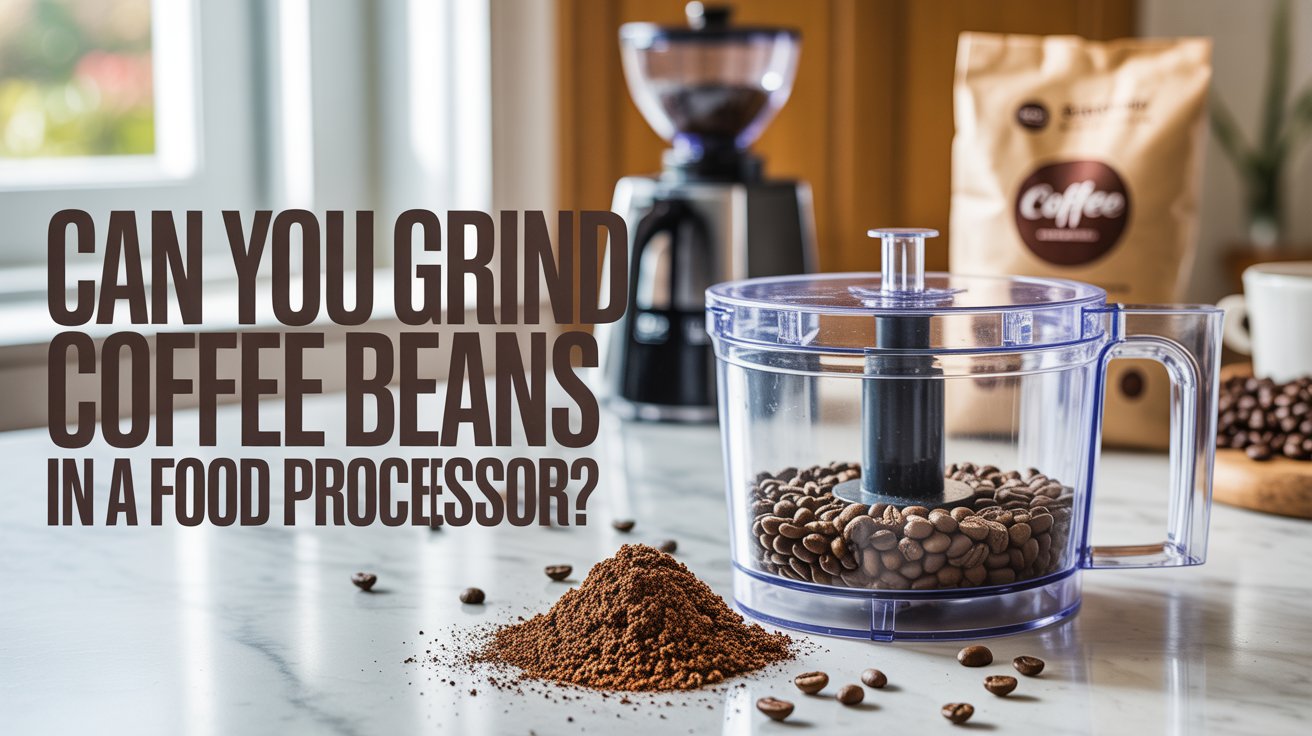
Yes, you can grind coffee beans in a food processor. It is a useful option for making coffee at home in the United States when you do not have a burr or blade coffee grinder.
The result will not be as even as a dedicated burr grinder. A food processor can also leave a mix of fine powder and large bean pieces. Still, with short pulses and a small batch, it can produce a workable grind for a French press, drip coffee maker, or cold brew.

Is a Food Processor Good for Grinding Coffee Beans?
A food processor is good for occasional coffee grinding, but it is not the best tool for daily use. Its wide bowl and blunt chopping blade move beans around instead of grinding every bean to the same size.
This creates an uneven grind. Some pieces may be very fine, while others remain coarse. Fine particles can make coffee taste bitter or muddy, while large pieces may produce weak coffee.
A food processor works best when:
- You need to grind a small amount of coffee.
- You are making French press or cold brew.
- You do not need exact grind control.
- You use short pulses and check the beans often.
A burr grinder is a better choice for espresso, pour-over coffee, and other methods that need a precise grind. Burr grinders crush beans between two surfaces. This usually creates more even particles than a food processor blade.
The National Coffee Association recommends grinding coffee close to the time of brewing. That advice applies whether you use a burr grinder, blade grinder, or food processor. Fresh grinding helps protect the aroma that coffee loses after exposure to air.

What Grind Size Should You Use?
Choose the grind size based on your brewing method. A food processor cannot control grind size as precisely as a coffee grinder, so use visual checks and short pulses.
| Brewing method | Target grind | Food processor result to seek |
|---|---|---|
| French press | Coarse | Pieces like coarse sea salt |
| Cold brew | Coarse to medium-coarse | Large, fairly even pieces |
| Drip coffee maker | Medium | Small grains, with few large pieces |
| Pour-over | Medium-fine | Fine grains, though results may vary |
| Espresso | Very fine | Food processor is not recommended |
For French press, stop before the beans become powdery. A coarse grind helps reduce sediment and can make the coffee easier to filter.
For drip coffee, aim for a texture similar to regular sand. The food processor may create some powder, so do not run it longer than needed.
For espresso, use a burr grinder made for espresso. Espresso requires a fine and consistent grind. A food processor usually cannot provide the control needed for proper pressure and flow.

How to Grind Coffee Beans in a Food Processor
Follow these steps to get the most even result possible.
1. Check the food processor
Make sure the bowl, lid, and blade are clean and dry. Water left in the bowl can affect the beans and may create a paste-like residue if coffee dust sticks to it.
Check the food processor manual before use. Most food processors can handle dry ingredients, but instructions vary by model. Do not use a damaged bowl, loose blade, or cracked lid.
2. Measure a small batch
Start with about 1/4 to 1/2 cup of whole coffee beans. A small batch gives the blade more room to move the beans.
Do not fill the bowl to the top. Too many beans can block movement and lead to a poor grind. A crowded bowl may also place extra strain on the motor.
If you need more coffee, grind in separate batches. This takes longer but usually gives you better control.
3. Add the beans
Place the beans in the bowl and secure the lid. Keep the food processor on a stable surface.
Do not add water, oil, sugar, or other ingredients. Coffee beans should be ground dry.
4. Use short pulses
Press the pulse button for about 1 to 2 seconds at a time. Stop between pulses so the beans can settle.
For a coarse grind, use only a few pulses. For a medium grind, use more pulses. Avoid holding the button down for a long period.
Long blending can:
- Heat the beans.
- Create excess coffee dust.
- Produce an uneven powder.
- Make the motor work harder.
- Increase the chance of over-grinding.
The exact number of pulses depends on the food processor, batch size, and bean type. Treat the times below as a starting point, not a fixed rule.
| Desired result | Starting approach |
|---|---|
| Coarse grind | Pulse 3 to 5 times |
| Medium grind | Pulse 6 to 10 times |
| Fine grind | Use a dedicated grinder instead |
5. Shake the bowl between pulses
Turn off and unplug the food processor before opening the lid. Gently shake the bowl so larger pieces move toward the blade.
This step helps reduce uneven grinding. Do not shake the machine while it is running.
6. Check the texture
Open the bowl and inspect the beans under good light. Remove any large pieces that clearly need more grinding.
Do not judge the grind only by time. The same number of pulses can produce different results in different machines.
7. Transfer and brew
Pour the ground coffee into your filter, French press, or storage container. Brew it soon after grinding for the best flavor.
If you have too much coffee dust, use a paper filter or a fine-mesh filter to reduce sediment. Do not rinse ground coffee, since water will remove flavor and change the brewing ratio.

How Much Coffee Should You Grind?
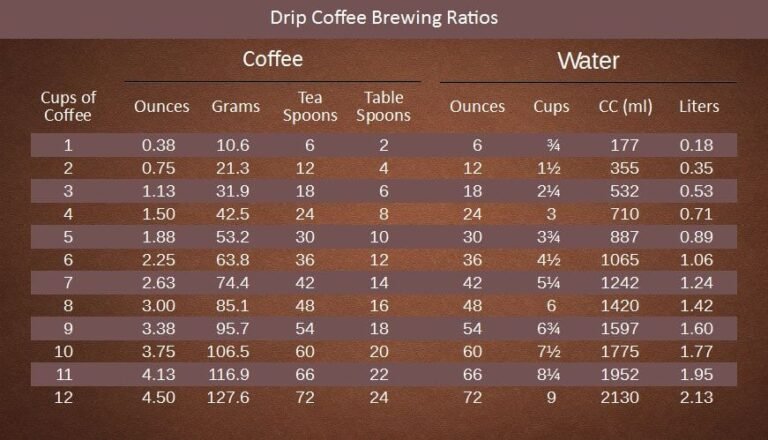
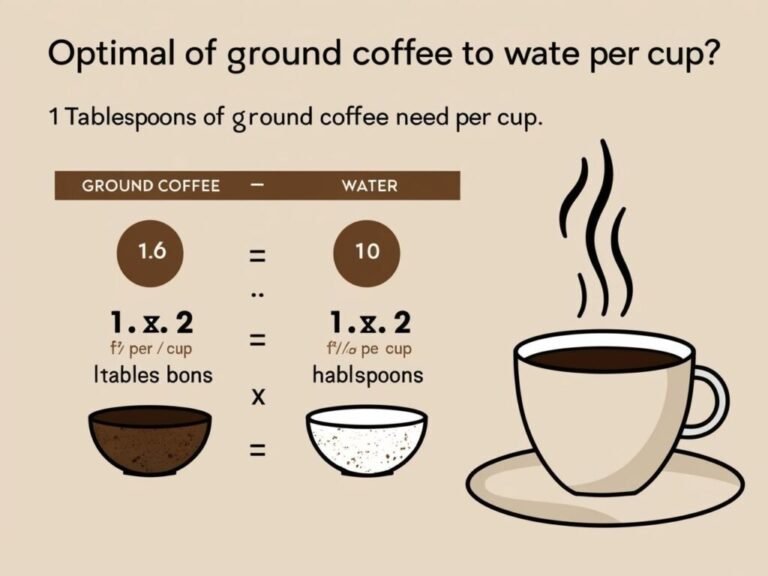
A common starting point is about 1 to 2 tablespoons of ground coffee for every 6 fluid ounces of water. This is only a starting point. Your preferred strength, coffee type, and brewer may call for a different amount.
For a simple example:
- 12 fluid ounces of water: start with about 2 to 4 tablespoons.
- 24 fluid ounces of water: start with about 4 to 8 tablespoons.
- 32 fluid ounces of water: start with about 5 to 11 tablespoons.
These amounts are approximate because tablespoons measure volume, while coffee recipes are more consistent when measured by weight.
A kitchen scale can help. Many coffee brewers use a coffee-to-water ratio near 1:16 as a starting point. For example, 30 grams of coffee with 480 grams, or about 480 milliliters, of water gives a 1:16 ratio.
This ratio is not a rule. Adjust it after tasting:
- Weak or watery coffee: use more coffee or a finer grind.
- Bitter or harsh coffee: use less coffee, a coarser grind, or a shorter brew time.
- Sour or thin coffee: use a finer grind or a longer brew time.

How to Get a More Even Grind
A food processor will always have limits, but a few habits can improve the result.
Use short pulses
Short pulses give you more control than continuous blending. They also help limit heat and reduce the chance of turning part of the batch into powder.
Grind fewer beans
A smaller batch allows the blade to reach more beans. If the bowl is crowded, some beans may stay near the top while others are chopped repeatedly at the bottom.
Shake between pulses
Coffee beans can settle in one area of the bowl. Shaking helps move them into the blade’s path.
Stop before the smallest pieces become dust
You cannot make every piece identical in a food processor. Aim for a reasonable range instead of trying to create a perfectly uniform grind.
Use the coffee soon
Ground coffee has more exposed surface area than whole beans. That exposure allows aroma to fade faster. Store extra ground coffee in an airtight container away from heat, light, and moisture.
Do not store coffee in the food processor bowl. The bowl may hold odors from onions, garlic, spices, or other foods.

What Can Go Wrong?
Most problems come from an unsuitable grind, an oversized batch, or a dirty bowl.
| Problem | Likely cause | What to do |
|---|---|---|
| Coffee tastes bitter | Too much fine dust or over-extraction | Use fewer pulses or a coarser grind |
| Coffee tastes weak | Pieces are too large or brewing time is too short | Pulse slightly longer or adjust the recipe |
| Large bean pieces remain | Bowl is too full or beans are not moving | Use a smaller batch and shake the bowl |
| Coffee tastes stale | Beans or grounds were stored too long | Grind only what you need |
| Coffee smells like food | Bowl or blade held old odors | Wash and dry the parts well |
| Machine becomes hot | Long, continuous blending | Stop, let the motor cool, and use short pulses |
| Coffee has too much sediment | Uneven grind and fine particles | Use a paper or fine-mesh filter |
If the food processor smells hot, makes an unusual sound, or shows signs of strain, stop using it. Unplug the machine and follow the manufacturer’s care instructions.
Never put your hands near the blade, even when the machine appears to be off. Unplug it before removing stuck beans or cleaning around the blade.

Food Processor vs. Coffee Grinder
A food processor is convenient, but a coffee grinder gives better control.
| Feature | Food processor | Blade coffee grinder | Burr coffee grinder |
|---|---|---|---|
| Availability | Common in many kitchens | Made for small coffee batches | Made for coffee grinding |
| Grind consistency | Low to moderate | Low to moderate | Moderate to high |
| Control | Pulse-based | Pulse or timed use | Often adjustable |
| Best use | Occasional coarse or medium grind | Occasional basic grinding | Regular coffee and precise brewing |
| Espresso suitability | Poor | Poor to limited | Best option |
| Batch size | Often larger | Usually smaller | Varies by model |
| Cleanup | May retain food odors | Usually simple | Requires regular cleaning |
A blade coffee grinder may be easier to control than a food processor because its smaller chamber is designed for coffee beans. A burr grinder costs more, but it is the better fit for people who brew coffee often or use pour-over, AeroPress, moka pot, or espresso equipment.
The decision is simple: use a food processor when convenience matters more than precision. Use a burr grinder when grind consistency matters more than convenience.
Can You Grind Coffee Beans in a Mini Food Processor?
Yes, a mini food processor can grind coffee beans if its manual allows dry ingredients and the bowl is suitable for the task.
A small bowl may help because the beans stay closer to the blade. However, it can also become crowded quickly. Use a small amount and stop often to check the texture.
Do not assume that a mini food processor is the same as a coffee grinder. Some mini processors use plastic parts or attachments that are not designed for hard, dry foods. Check the care and use instructions for your specific model.

Can You Grind Coffee Beans in a Blender?
A blender can grind coffee beans, but it may produce the same uneven result as a food processor. The narrow shape may help move beans toward the blade, but the result still depends on the blade design, batch size, and pulse control.
Use a blender only if its manufacturer permits dry ingredients. A high-speed blender may create a large amount of fine powder very quickly. That can make French press coffee gritty or bitter.
A food processor is often easier to inspect because its bowl is wider and more open. Neither appliance replaces a burr grinder for precise brewing.

How to Clean a Food Processor After Grinding Coffee
Clean the bowl, lid, blade, and seals after grinding coffee. Coffee oils can cling to plastic and may leave an odor.
- Unplug the food processor.
- Remove the blade carefully.
- Empty all coffee grounds.
- Wash removable parts with warm water and dish soap, if the manual permits.
- Use a soft brush around the blade and lid grooves.
- Rinse and dry every part fully.
- Wipe the motor base with a damp cloth only.
Do not place the motor base in water. Do not use abrasive pads on plastic parts unless the manufacturer says they are safe.
If the bowl still smells like coffee, wash it again with a small amount of baking soda and dish soap. Rinse well before using it for other foods. Avoid using strong cleaners that could leave a residue.

Key Takeaways
- You can grind coffee beans in a food processor.
- Use a small batch and short pulses.
- Shake the bowl between pulses for a more even result.
- A food processor works best for French press, cold brew, and basic drip coffee.
- It is not a good choice for espresso.
- Stop if the motor smells hot or sounds strained.
- Clean the bowl well to prevent coffee odors from affecting other foods.
- Choose a burr grinder if you want consistent results for regular coffee brewing.
Frequently Asked Questions
Will a food processor damage coffee beans?
No. A food processor can chop coffee beans, provided the appliance is designed to handle dry ingredients and you follow its manual. The main concern is not damage to the beans. It is the uneven grind and possible strain from overfilling or running the machine too long.
Does grinding coffee in a food processor make it bitter?
It can. A food processor may create extra-fine particles while leaving large pieces behind. The fine particles can extract quickly and add bitter flavors. Short pulses and a coarse grind can reduce this problem.
Should coffee beans be frozen before grinding?
Freezing is not required for a food processor. Use dry, room-temperature beans unless you have a specific storage reason for freezing them. If beans are frozen, avoid adding moisture from condensation to the appliance.
Can I grind flavored coffee beans in a food processor?
Yes, but flavored beans may leave oils and scents in the bowl. Clean the food processor well afterward. If the bowl retains the flavor, future foods may pick up the smell.
Is a food processor better than a mortar and pestle for coffee?
A food processor is faster and requires less hand work. A mortar and pestle can provide more control for a very small batch, but it also creates an uneven grind and takes more time. Neither method matches a burr grinder for consistency.
Conclusion
A food processor can grind coffee beans when you need a practical backup method. Use a small batch, pulse in short bursts, shake the bowl, and stop when the beans reach the texture your brewing method needs.
For the best results, use the grounds soon after grinding and choose a coarse grind for French press or cold brew. If you brew coffee often or need espresso-level control, invest in a burr grinder instead.



One Comment