The best commercial espresso machine for a small coffee shop balances speed, drink quality, ease of use, and long-term value.
Opening a small coffee shop can feel exciting until the morning rush begins. A slow machine, weak steam power, or hard-to-clean parts can quickly create long lines and unhappy guests. I reviewed nine espresso machines with different strengths, from dual-boiler designs to compact automatic models. This guide to the 9 best commercial espresso machine small coffee shop options will help you match the machine to your menu, staff, counter space, and daily drink volume.
See the differences between my top picks at a glance.
| Machine | Best For | Key Setup | Milk System | Main Limitation | Check Price |
|---|---|---|---|---|---|
| AMZCHEF Dual Boiler | Small shops needing control | Dual boiler, PID, 58mm portafilter | Automatic frother | Newer brand to assess | View on Amazon |
| Nuova Simonelli Appia Life | Busy espresso service | Two groups, auto volumetric | Commercial steam system | Large investment | View on Amazon |
| COWSAR 15-Bar Machine | Entry-level café service | Integrated grinder and tools | Steam wand | Less suited to heavy rushes | View on Amazon |
| Chefman 8-in-1 Station | Mixed coffee menus | 20-bar pump, 3L tank | Automatic frother | Counter footprint | View on Amazon |
| Chefman CraftBrew | Compact coffee counters | 15-bar pump, 1.5L tank | Steam wand | Small water reservoir | View on Amazon |
| De’Longhi La Specialista Arte Evo | Hands-on drink making | Built-in grinder, four recipes | Manual frother | Not a two-group machine | View on Amazon |
| Breville Barista Express | Owner-operated shops | Built-in grinder, manual control | Manual steam wand | Slower for large queues | View on Amazon |
| Bosch 800 Series | High drink variety | Touchscreen, 36 drinks | Integrated milk container | High price and complexity | View on Amazon |
| De’Longhi Magnifica Evo | Simple one-touch service | Built-in grinder, seven recipes | Milk frother | Limited manual café control | View on Amazon |
AMZCHEF Dual Boiler Espresso Machine

The AMZCHEF machine stands out for its dual-boiler design and 9-bar OPV system. A dual boiler can help separate brewing from milk steaming, which matters when a small shop serves lattes and cappuccinos during a rush. The 58mm portafilter also follows a familiar café format. Its 1650W dual heating system, PID control, and NTC temperature control give the barista several ways to manage heat.
The automatic milk frother may appeal to a shop that wants repeatable drinks with less manual work. The LED display and custom settings can make daily operation easier after staff learn the controls. I would still confirm installation needs, warranty terms, and service support before using it as the only machine in a busy store. For a growing counter with moderate volume, it offers an impressive feature list.
Pros:
- Dual-boiler layout supports brewing and steaming tasks.
- PID and NTC controls help manage temperature.
- 9-bar OPV design targets balanced espresso pressure.
- 58mm portafilter suits common café accessories.
- Automatic milk frother can speed up simple milk drinks.
- LED display and custom settings add operating control.
Cons:
- It may require more staff training than a fully automatic model.
- AMZCHEF has less café history than established commercial brands.
- Owners should verify parts and service access before purchase.
What Amazon Buyers Are Saying
Amazon buyers typically focus on the dual-boiler design, temperature controls, and the range of included settings when reviewing a machine like this. Some buyers may prefer the automatic milk feature, while hands-on baristas may want more manual control. Reviews can change as more owners use the machine, so I suggest checking recent comments about heat recovery, cleaning, setup, and customer support before ordering.
My Recommendation
I recommend the AMZCHEF for a small coffee shop that wants advanced controls without immediately moving to a large two-group commercial machine. It is best for moderate service and a team willing to learn the system. I would not choose it blindly for very heavy volume without confirming support first.
Nuova Simonelli Appia Life 2 Group

The Nuova Simonelli Appia Life Auto Volumetric is the most café-focused machine in this list. Its two-group layout lets a barista prepare more than one espresso order at a time. Auto volumetric dosing can help staff repeat shot volumes with less guesswork. That feature is useful when several employees share the bar.
This machine makes the most sense for a real espresso program rather than a low-volume office or retail counter. It needs careful planning for power, water, drainage, ventilation, and counter space. The commercial design may justify the investment for a busy small café, but it costs more than compact single-group machines. I would also budget for professional setup and regular service.
Pros:
- Two groups support faster drink production.
- Auto volumetric dosing improves shot consistency.
- Established commercial design suits café work.
- Multiple baristas can work with the machine more easily.
- Strong choice for a menu built around espresso drinks.
Cons:
- It needs more counter space than compact home-style units.
- The purchase and installation cost can be high.
- It may be excessive for a shop with light espresso demand.
What Amazon Buyers Are Saying
Buyers who choose a Nuova Simonelli commercial machine often pay close attention to build quality, workflow, and shot consistency. Commercial users may value the two-group layout and automatic dosing. Some reviews may mention delivery, setup, or the need for a qualified technician. Read current buyer feedback closely because installation experiences can vary by seller and location.
My Recommendation
This is my strongest pick for a small coffee shop with steady customer traffic and a serious espresso menu. It is not the cheapest choice, but its two-group workflow can save time every day. Buy it when your sales volume can support a true commercial investment.
COWSAR 15-Bar Espresso Machine

The COWSAR combines an espresso machine, grinder, steam wand, and tamping tools in one package. That makes it attractive to a new coffee business with a tight equipment budget. The 15-bar pump rating gives it enough pressure potential for espresso preparation, although pressure alone does not guarantee a better shot. Grind size, dose, tamp, and fresh beans still matter greatly.
The white finish gives the machine a clean look on a small counter. The integrated grinder reduces the need to buy a separate grinder at the start. I see it as a practical entry point for light service, pop-up use, or a shop that sells more drip coffee than espresso. It may struggle to match the speed and recovery of a dedicated commercial two-group machine.
Pros:
- Includes a built-in grinder for a simpler setup.
- Steam wand supports cappuccinos and lattes.
- Included tamping tools reduce extra startup purchases.
- Compact all-in-one approach can save counter space.
- Useful for new owners with moderate drink volume.
Cons:
- It may not suit long, continuous rush periods.
- Built-in grinders offer less upgrade flexibility.
- New baristas still need practice with dosing and milk texture.
What Amazon Buyers Are Saying
Amazon shoppers looking at this type of machine often like the included grinder and tools because they can begin with one purchase. Buyers may also comment on the appearance and ease of making basic milk drinks. Common points to check in recent reviews include grinder adjustment, cleaning, noise, and how the machine performs after repeated use.
My Recommendation
The COWSAR is worth considering for a small shop that needs an affordable starter setup. I would use it for low to moderate demand, not as the main machine in a crowded morning café. It earns a good value score because it includes several useful pieces of equipment.
Chefman 8-in-1 Coffee Station

The Chefman 8-in-1 Coffee Station targets shops that serve more than espresso alone. It includes a 20-bar pump, automatic milk frother, 12-cup carafe, and 3-liter water tank. That mix can help a small business serve espresso drinks, brewed coffee, and milk-based recipes from one station. It is especially useful for a broad menu with different customer needs.
The large water tank can reduce refill work during service. The automatic frother also makes the machine easier for new staff to use. Still, an 8-in-1 unit may take more space and offer less hands-on control than a traditional café setup. I would measure the counter and review the cleaning steps before placing it in a busy service line.
Pros:
- Supports several coffee styles in one appliance.
- 3-liter water tank can reduce frequent refills.
- 12-cup carafe helps with brewed coffee service.
- Automatic frother simplifies milk-based drinks.
- Useful for shops with mixed beverage demand.
Cons:
- The larger station may crowd a narrow counter.
- It offers less traditional barista control.
- Cleaning several systems may take extra daily effort.
What Amazon Buyers Are Saying
Buyers commonly look at the convenience of combining several drink functions in one machine. Feedback may praise the water capacity and menu range, while some users may prefer a smaller espresso-only unit. Before buying, check current reviews for comments about the carafe, frother cleaning, controls, and the space needed around the appliance.
My Recommendation
I recommend this machine for a small café, bakery, or snack shop with a wide menu. It is less suitable for a specialty espresso bar that needs maximum control over every shot. Its best value comes from replacing several separate drink stations.
Chefman CraftBrew Espresso Machine
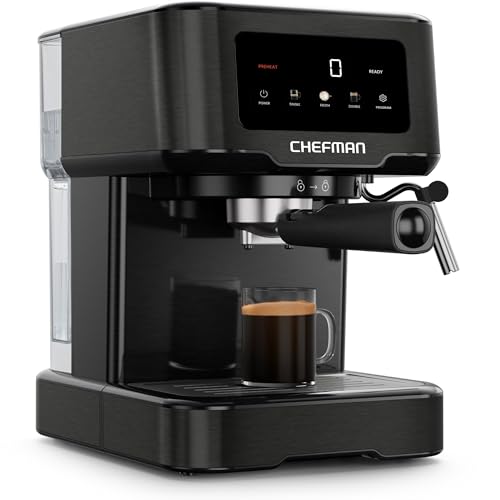
The Chefman CraftBrew focuses on simple espresso preparation in a compact body. Its 15-bar pump, digital controls, steam wand, and 1.5-liter removable water reservoir cover the basics for lattes and cappuccinos. The removable tank makes refilling and cleaning easier in a small work area. Its stainless black finish also fits many modern counters.
This machine suits an owner-operated coffee counter or a shop with modest espresso demand. The smaller reservoir means staff may need to refill it during a busy shift. A manual steam wand gives more control than an automatic frother, but it also requires practice. I like it as a low-cost way to add espresso drinks without giving up much counter space.
Pros:
- Compact design fits smaller counters.
- Removable 1.5-liter tank simplifies refilling.
- Digital controls make basic operation clear.
- Steam wand allows manual milk-texture control.
- Good fit for light café or food-service use.
Cons:
- The water tank is smaller than those on larger stations.
- It may not keep pace with a high-volume espresso bar.
- Manual steaming requires staff practice.
What Amazon Buyers Are Saying
Customers often assess compact machines by how quickly they learn the controls and how easy the removable tank is to handle. Buyers may enjoy making café-style drinks at a smaller price, while some may want a larger reservoir for frequent service. Look for recent comments on heat-up time, steam strength, cleaning, and long-term reliability.
My Recommendation
The CraftBrew is a sensible pick when space and budget matter most. I would choose it for a small bakery, kiosk, or owner-run shop with a short espresso menu. It is not my first choice for nonstop commercial production.
De’Longhi La Specialista Arte Evo

The De’Longhi La Specialista Arte Evo brings grinding, espresso brewing, and milk frothing into one hands-on system. It includes four preset recipes and a built-in grinder. The included barista toolkit can help with dosing and tamping. This makes the machine appealing to a small shop that wants staff to take part in the drink-making process.
I like this model for a café that sells quality drinks but does not need two baristas pulling shots at once. The manual frother gives better learning value than a push-button milk system. However, the built-in grinder and single-machine workflow can limit speed during a rush. It is a better match for a craft-focused counter than a high-volume production bar.
Pros:
- Built-in grinder keeps the setup tidy.
- Four preset recipes help staff start quickly.
- Manual frother supports better milk practice.
- Included toolkit helps with basic barista tasks.
- Good balance of convenience and hands-on control.
Cons:
- Single-machine workflow may slow a busy queue.
- Built-in grinder cannot be upgraded separately.
- Staff need training to produce repeatable results.
What Amazon Buyers Are Saying
Amazon buyers often value the built-in grinder and the chance to make drinks with a more traditional process. Reviews may praise the recipe presets and toolkit, while some users may need time to learn grind and tamp settings. Check current feedback for grinder adjustment, cleaning, milk steaming, and consistency across different beans.
My Recommendation
This is a strong choice for a small coffee shop that wants a craft feel and a manageable learning curve. It can produce a pleasing range of drinks, but I would not use it alone for a large morning rush. It earns high marks for owner-operated service.
Breville Barista Express Espresso Machine

The Breville Barista Express remains popular with people who want control over the full espresso process. It combines a grinder, espresso maker, portafilter, and manual steam wand in one unit. A pressure gauge can help a learner understand how the extraction is going. Its familiar layout also makes it a useful training machine for a new owner or staff member.
This model is best when one person handles the bar and customers do not arrive in a constant wave. It can make quality drinks, but its home-style workflow is slower than a commercial two-group machine. The built-in grinder saves space, yet a separate grinder may offer more flexibility later. For a small coffee shop with moderate demand, it remains a practical and well-known option.
Pros:
- Built-in grinder saves counter space.
- Manual steam wand supports latte art practice.
- Pressure gauge helps with extraction learning.
- Many staff members find the layout familiar.
- Strong option for owner-operated service.
Cons:
- It is slower than a true two-group commercial machine.
- Manual dosing and steaming take staff time.
- One integrated grinder limits future equipment upgrades.
What Amazon Buyers Are Saying
Buyers often mention the learning value, built-in grinder, and ability to make café-style drinks at home or in a small workplace. Some users may need time to dial in the grinder and learn milk steaming. Recent reviews are most useful when they discuss cleaning, grinder adjustment, noise, and performance after regular daily use.
My Recommendation
I recommend the Barista Express for a very small, owner-run coffee shop or a low-volume espresso counter. It offers good control and a strong support community. Choose another model if your business expects a long queue of milk drinks every morning.
Bosch 800 Series Fully Automatic Coffee Machine

The Bosch 800 Series is built for convenience and drink variety. Its touchscreen, double-cup function, large bean capacity, integrated milk container, and selection of 36 drinks make it different from manual espresso machines. It can also save up to 30 profiles, which may help a café, showroom, or hospitality space handle different preferences. The cold brew option adds another menu path.
This machine is a strong fit when speed and simple button-based service matter more than manual espresso craft. Staff can prepare drinks with less training, and guests can choose from many recipes. The trade-off is less control over each shot and more electronic complexity. I would plan a clear cleaning routine for the milk system and confirm that the machine suits the intended commercial workload.
Pros:
- 36 drink choices support a broad menu.
- Touchscreen operation can shorten staff training.
- Double-cup function helps with paired orders.
- Large bean capacity may reduce refills.
- Profiles allow drink preferences to be saved.
- Integrated milk container keeps the counter organized.
Cons:
- It costs more than basic manual machines.
- Automatic brewing gives baristas less direct control.
- Milk-system cleaning must remain consistent.
What Amazon Buyers Are Saying
Buyers usually focus on the touchscreen, drink range, and one-touch convenience. Many shoppers also consider the value of saved profiles and the integrated milk setup. Since fully automatic machines include more parts and software, read recent reviews for cleaning, error messages, noise, drink temperature, and customer service.
My Recommendation
The Bosch 800 Series is worth considering for a premium self-service area or a café with many drink preferences. It is not my first pick for a traditional barista-led espresso bar. Its strongest benefit is fast, broad, and consistent menu service.
De’Longhi Magnifica Evo Automatic Machine

The De’Longhi Magnifica Evo is a simple automatic espresso machine with seven one-touch recipes. It has a built-in grinder and milk frother, so staff can prepare drinks without learning every manual step. This can help a small shop keep service steady when employees have different skill levels. The silver finish also gives it a clean and modern appearance.
The machine works best in a light-service setting, such as a small bakery, salon, hotel lounge, or café with a limited espresso menu. One-touch convenience saves time, but it also reduces the ability to adjust every part of extraction. The built-in grinder keeps the station compact. I would choose it when ease of use matters more than traditional barista technique.
Pros:
- Seven one-touch recipes simplify daily service.
- Built-in grinder keeps the station compact.
- Milk frother supports common café drinks.
- Easy controls suit mixed-experience staff.
- Good option for low to moderate drink demand.
Cons:
- It offers less manual control than a portafilter machine.
- Automatic milk systems need regular cleaning.
- It may not meet the needs of a high-volume espresso bar.
What Amazon Buyers Are Saying
Amazon buyers often like the one-touch recipes and the reduced work during drink preparation. New users may appreciate the built-in grinder and simple controls. As with any automatic machine, recent reviews can reveal useful details about cleaning, drink temperature, foam texture, grinder noise, and the availability of replacement parts.
My Recommendation
I recommend the Magnifica Evo for a small business that wants reliable convenience and a short training period. It is not ideal for a specialty coffee shop where guests expect manual extraction and latte art. For simple service, it offers a practical balance of features and size.
How to Choose the 9 Best Commercial Espresso Machine Small Coffee Shop
Choosing among the 9 best commercial espresso machine small coffee shop options starts with your real service needs. A machine that works well for 30 drinks per day may fail during a 200-drink weekend. Think about drink volume, staff skill, menu style, counter space, water access, cleaning time, and repair support. The best machine is not always the one with the highest pressure number or the most buttons.
1. Match the Machine to Daily Drink Volume
Estimate your busiest hour, not only your daily average. If you expect a steady line, a two-group commercial machine can save time because it allows more than one espresso workflow at once. Auto volumetric dosing can also help different staff members repeat shot volumes.
For a quiet bakery or owner-run kiosk, a compact single-group machine may provide better value. Automatic machines can work well when you sell many drink types but do not need a traditional barista station. Leave room for growth, but avoid paying for capacity that your shop cannot use.
2. Compare Brewing Control and Milk Workflow
Look for useful controls such as PID temperature management, a stable group head, and a suitable portafilter if espresso quality is central to your brand. A dual-boiler setup can help when staff must brew and steam close together. Still, good beans, a proper grind, an even tamp, and clean equipment affect the cup just as much.
Then decide between a manual steam wand and an automatic frother. A manual wand gives better control and supports latte art. An automatic frother helps new staff make repeatable drinks with less training. For a mixed team, ease of use may matter more than maximum control.
3. Check Installation, Cleaning, and Long-Term Value
Before buying a commercial espresso machine, measure the counter depth, height, and working space. Confirm the power requirements and ask whether the machine needs a water line, drain, or special setup. A large tank helps in some shops, while a plumbed commercial machine may work better in a permanent café.
Cleaning should be part of the buying decision. Staff must backflush suitable machines, wipe steam wands after every use, empty drip trays, and clean milk parts as directed. Ask about warranty coverage, local technicians, replacement parts, and seller support. A lower purchase price means little if a failed machine closes your coffee station.
Final Verdict: Which Should You Buy?
For a busy small café, I would choose the Nuova Simonelli Appia Life. For moderate service and advanced control, the AMZCHEF dual-boiler model is more practical. The Bosch and De’Longhi automatic machines suit broad menus and simple operation.
The best 9 best commercial espresso machine small coffee shop choice depends on volume, staff, space, and menu. Measure first, plan cleaning, and confirm service support before ordering.
FAQs Of 9 best commercial espresso machine small coffee shop
What is the best commercial espresso machine for a small coffee shop?
The Nuova Simonelli Appia Life is the strongest choice for steady café traffic because its two-group design supports faster service. The AMZCHEF is a good alternative for moderate volume and more compact operation.
Can a small coffee shop use a home-style espresso machine?
Yes, a home-style machine can work for light service or an owner-run counter. It may not handle a long rush as well as a true commercial machine.
Is a dual-boiler espresso machine worth it for a small café?
It can be worth it when staff brew espresso and steam milk often. A dual-boiler design may improve workflow, but it usually costs more and needs careful setup.
Should a small coffee shop choose an automatic or manual espresso machine?
Choose automatic for fast training and simple recipes. Choose manual when espresso control, milk texture, and barista craft are central to your menu.
What should I check before buying a commercial espresso machine?
Check drink volume, counter space, power needs, water setup, cleaning steps, warranty coverage, replacement parts, and local repair support.