
No. You do not have to grind coffee beans yourself to make French press coffee. You can use coffee that is already ground.
However, if you start with whole beans, you must grind them before brewing. A coarse grind usually works best because it helps the filter separate the coffee from the grounds. It also reduces muddy coffee and bitter flavors.
For most home brewers in the United States, the best options are:
- Freshly ground coffee with a coarse setting
- Coarse pre-ground coffee made for French press
- A simple ratio of about 1 part coffee to 15–17 parts water
- A brew time of about 4 minutes
The main trade-off is freshness. Grinding whole beans just before brewing often gives a brighter aroma and fuller flavor. Pre-ground coffee is easier, but it may taste flatter if it has been open for a long time.
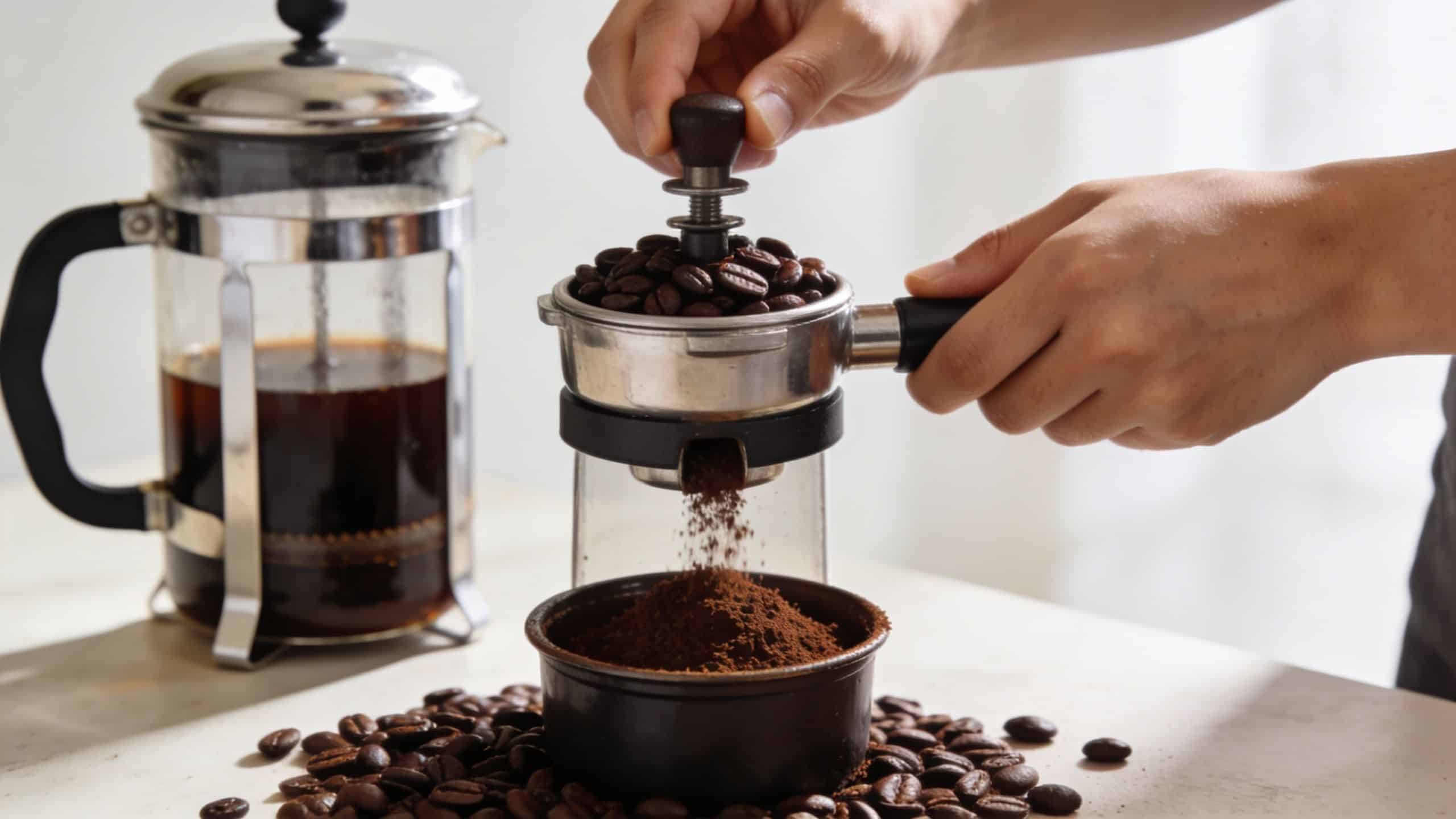
What Grind Should You Use for French Press Coffee?
Use a coarse grind, with particles that look a little like coarse sea salt. French press filters have larger openings than paper filters, so very fine coffee can pass through the mesh.
A coarse grind also slows extraction. This matters because French press coffee sits in hot water for several minutes. Fine grounds release flavor compounds more quickly. That can lead to bitter or harsh coffee when the brew time is long.
How grind size changes your cup
| Grind size | Likely result in a French press |
|---|---|
| Coarse | Cleaner cup, easy plunging, balanced extraction |
| Medium-coarse | Stronger extraction, some sediment |
| Medium | More body, higher risk of bitterness and sludge |
| Fine | Muddy cup, difficult plunging, harsh taste |
| Extra-fine | Usually unsuitable; may clog the filter |
The ideal setting varies by grinder. One grinder’s “coarse” setting may look like another grinder’s “medium.” Use the appearance of the grounds and the taste of the coffee as your guide.
Why coarse coffee works well
French press brewing uses immersion. The coffee grounds remain surrounded by water during the brew. Because the water has direct contact with the grounds for several minutes, the coffee does not need a fine grind to release flavor.
A coarse grind also makes it easier to press the plunger. If the plunger feels hard to push, the coffee may be too fine, the filter may be clogged, or the coffee may contain too many small particles.

Do You Need to Grind Whole Coffee Beans Yourself?
No. You can ask a coffee shop to grind the beans for a French press, buy a bag labeled “French press grind,” or use coffee that is already ground at home.
Grinding coffee yourself is helpful because ground coffee begins losing aroma faster than whole beans. The speed of that change depends on storage, packaging, air exposure, heat, and time. It does not mean pre-ground coffee is unusable.
Your main choices
1. Grind whole beans at home
This gives you the most control over:
- Grind size
- Coffee freshness
- Dose, or the amount of coffee used
- Adjustments between brews
A burr grinder usually produces more even particles than a blade grinder. More even grounds can make extraction easier to control.
2. Buy coarse pre-ground coffee
This is the simplest choice. Look for packaging that says:
- French press
- Coarse grind
- Press pot
- Cafetière
Store the coffee in a sealed container away from heat, light, and moisture. Avoid keeping it beside a stove or in a damp area.
3. Ask a coffee shop to grind the beans
Tell the barista that you will use a French press. This can work well if you plan to use the coffee within a reasonable time and keep it sealed.
Can you use regular pre-ground coffee?
Yes, but “regular” can mean different things. Coffee sold for automatic drip machines is often medium-ground. It may work in a French press, but it can leave more sediment than a coarse grind.
If medium-ground coffee tastes bitter, reduce the brew time or use slightly cooler water. If it tastes weak, increase the coffee dose or let it brew a little longer.

How to Make French Press Coffee With Ground Coffee
You need a French press, coffee, hot water, a timer, and a spoon. A kitchen scale is useful because measuring coffee by weight gives more consistent results than using scoops.
A reliable starting recipe
For a standard 12-ounce US mug:
- 21–24 grams of coffee
- 12 fluid ounces, or about 355 grams, of water
- Water at about 195–205°F
- A brew time of about 4 minutes
- Coarse-ground coffee
This follows a starting ratio of roughly 1:15 to 1:17. The first number is the coffee weight, and the second is the water weight.
For example:
| Water | Coffee at 1:15 | Coffee at 1:17 |
|---|---|---|
| 355 g | 24 g | 21 g |
| 500 g | 33 g | 29 g |
| 750 g | 50 g | 44 g |
| 1,000 g | 67 g | 59 g |
These are starting points, not strict rules. Use more coffee for a stronger cup. Use less coffee for a lighter cup.
Step-by-step method
- Heat the water. Bring it to a boil, then let it cool briefly if you do not have a temperature-controlled kettle.
- Add the coffee. Put the coarse grounds in the empty French press.
- Pour in the water. Wet all the grounds. Pour slowly and evenly.
- Stir gently. Use a spoon to make sure no dry pockets remain.
- Start the timer. Let the coffee steep for about 4 minutes.
- Press slowly. Push the plunger down with steady, light pressure.
- Serve right away. Pour the coffee into a mug or separate carafe.
Do not force the plunger. Excess pressure can send hot liquid over the rim. It can also disturb the grounds and push more sediment into the cup.
Signs that the brew is working
A well-balanced French press coffee often has:
- A clear coffee aroma
- A full but not gritty texture
- Little harsh bitterness
- No dry or sour aftertaste
- A plunger that moves with moderate resistance
The French press should not behave like a sealed pressure device. If the plunger will not move, stop and check the grind and filter.

Can You Use Fine Coffee Grounds in a French Press?
You can, but fine grounds are usually a poor match for French press brewing. They can slip through the mesh, clog the filter, and make the coffee thick or gritty.
Fine grounds also extract more quickly. With a four-minute brew, the result may taste bitter, dry, or overly strong. If fine coffee is all you have, you can still make a drinkable cup by shortening the brew time.
Try this adjustment:
- Use the same coffee-to-water ratio.
- Brew for about 2–3 minutes.
- Press very slowly.
- Pour the coffee through an extra filter if the sediment is unpleasant.
This is a temporary workaround, not the ideal method. A coarse grind gives you more control.
What if the plunger is hard to press?
Stop pushing if the plunger resists strongly. Check these possible causes:
- The coffee is too fine.
- There are too many grounds for the filter size.
- The filter is bent or blocked.
- The plunger is not sitting straight.
- The coffee contains many fine particles.
Let the press sit for a moment, then try a small, gentle movement. If it still will not move, remove the plunger carefully and dilute or filter the coffee another way.
What if the coffee tastes weak?
Weak coffee may result from too little coffee, too much water, a short brew time, or water that is not hot enough.
Change one variable at a time:
- Add 2–4 grams more coffee.
- Extend the brew by 30–60 seconds.
- Use hotter water within the recommended range.
- Check that the grind is not unusually coarse.
What if the coffee tastes bitter?
Bitter coffee may come from over-extraction, very dark-roasted beans, water that is too hot, or a grind that is too fine.
Try:
- A slightly coarser grind
- A shorter brew time
- A lighter coffee dose
- Water just below boiling
- Freshly cleaned equipment
Coffee oils and old residue can also create stale or bitter flavors. Wash the beaker, plunger, and filter after each use.

French Press Grind Size: Freshly Ground vs. Pre-Ground Coffee
Freshly ground coffee is not automatically better if the grind is uneven or the recipe is poorly adjusted. Pre-ground coffee can make excellent French press coffee when it has a suitable grind and has been stored well.
| Factor | Freshly ground | Pre-ground |
|---|---|---|
| Freshness | Usually higher | Depends on age and storage |
| Convenience | Requires a grinder | Ready to use |
| Control | High | Limited |
| Consistency | Depends on grinder | Depends on the original grind |
| Cost | Requires equipment if you buy a grinder | No grinder needed |
The best choice depends on what matters most to you. Choose a grinder if you want to adjust your recipe and preserve more aroma. Choose pre-ground coffee if speed, simplicity, or budget matters more.
A French press does not require expensive equipment. A basic coarse-ground coffee, clean press, and sensible ratio can produce a good cup.

Common French Press Mistakes
Avoiding a few simple mistakes can improve the result more than buying new equipment.
Using boiling water directly
Water at a full boil can make some coffee taste harsh, especially with dark roasts. Let boiling water rest briefly, or use a kettle with a temperature setting near 200°F.
Leaving coffee in the press
After pressing, transfer the coffee to a mug or separate container. Coffee left in the press continues to sit with the grounds. It may become stronger, bitter, or dry.
Measuring by volume only
A scoop can hold different amounts of coffee depending on the grind and how tightly it is packed. A scale gives more reliable results.
Pressing too fast
A fast plunge can stir up the grounds and increase sediment. Press slowly and stop if the filter becomes difficult to move.
Rinsing but not cleaning
Coffee oils can cling to the mesh. Take apart the plunger when possible and wash each part. Rinse away soap well, then let the pieces dry.
Assuming every French press has the same capacity
Manufacturers may describe a press by different “cup” sizes. Check the actual liquid capacity in ounces or milliliters. A small press may not hold a full 12-ounce US mug.

Frequently Asked Questions
Can I use coffee beans without grinding them?
No. Whole beans will not extract well in a French press because water cannot reach enough surface area. Grind the beans before brewing, or buy coffee that is already ground.
Is French press coffee stronger than drip coffee?
It can taste fuller because the metal filter allows more coffee oils and fine particles into the cup. “Stronger” can mean more flavor, more body, or more caffeine, so the answer depends on the recipe and serving size.
Can I use espresso-ground coffee in a French press?
You can, but it is not recommended. Espresso-ground coffee is usually too fine for the long immersion time and metal filter. It may produce bitter, muddy coffee and a difficult-to-press plunger.
Should I grind coffee immediately before making French press coffee?
Yes, if you use whole beans. Grinding just before brewing usually preserves more aroma than grinding far in advance. Use a coarse setting and adjust it based on taste.
Can I make cold brew in a French press?
Yes. A French press can work as a small cold-brew vessel, but the grind, steep time, and ratio differ from hot French press coffee. Use coarse coffee, cold water, and a much longer steep. Strain carefully because the built-in mesh may allow fine sediment through.
Key Takeaways
- You do not have to grind coffee beans yourself.
- Whole beans must be ground before French press brewing.
- Coarse coffee is usually the best choice.
- Pre-ground coffee can work well if it is coarse and stored properly.
- Start with a 1:15–1:17 coffee-to-water ratio.
- Brew for about 4 minutes, then press slowly.
- If the coffee is bitter or muddy, the grind may be too fine or the brew may be too long.
- If the coffee is weak, use more coffee or extend the brew slightly.
Conclusion
French press coffee does not require a personal grinder. The key is using coffee that is ground coarse enough for the metal filter and the longer immersion time.
For the easiest method, buy coarse-ground coffee and use it with hot water for about 4 minutes. For greater freshness and control, grind whole beans just before brewing. Start with a 1:15–1:17 ratio, then make small changes until the cup tastes balanced.

2 Comments