Introduction
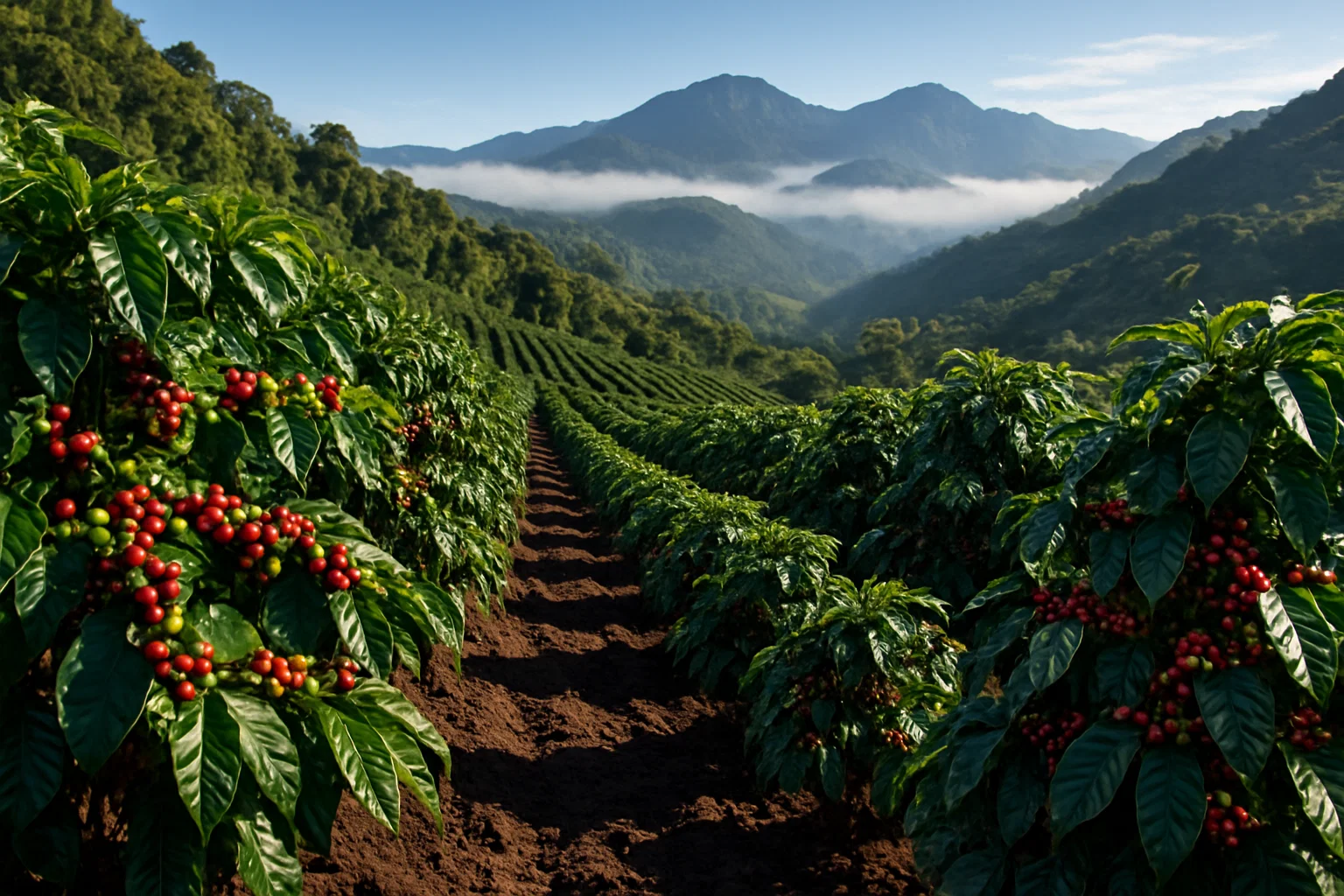
For coffee drinkers in the United States, the beans in a morning cup often travel thousands of miles before reaching a local café or grocery store. Most U.S. coffee is imported from countries near the equator, where warm weather, steady rain, rich soil, and high mountains help coffee plants grow.
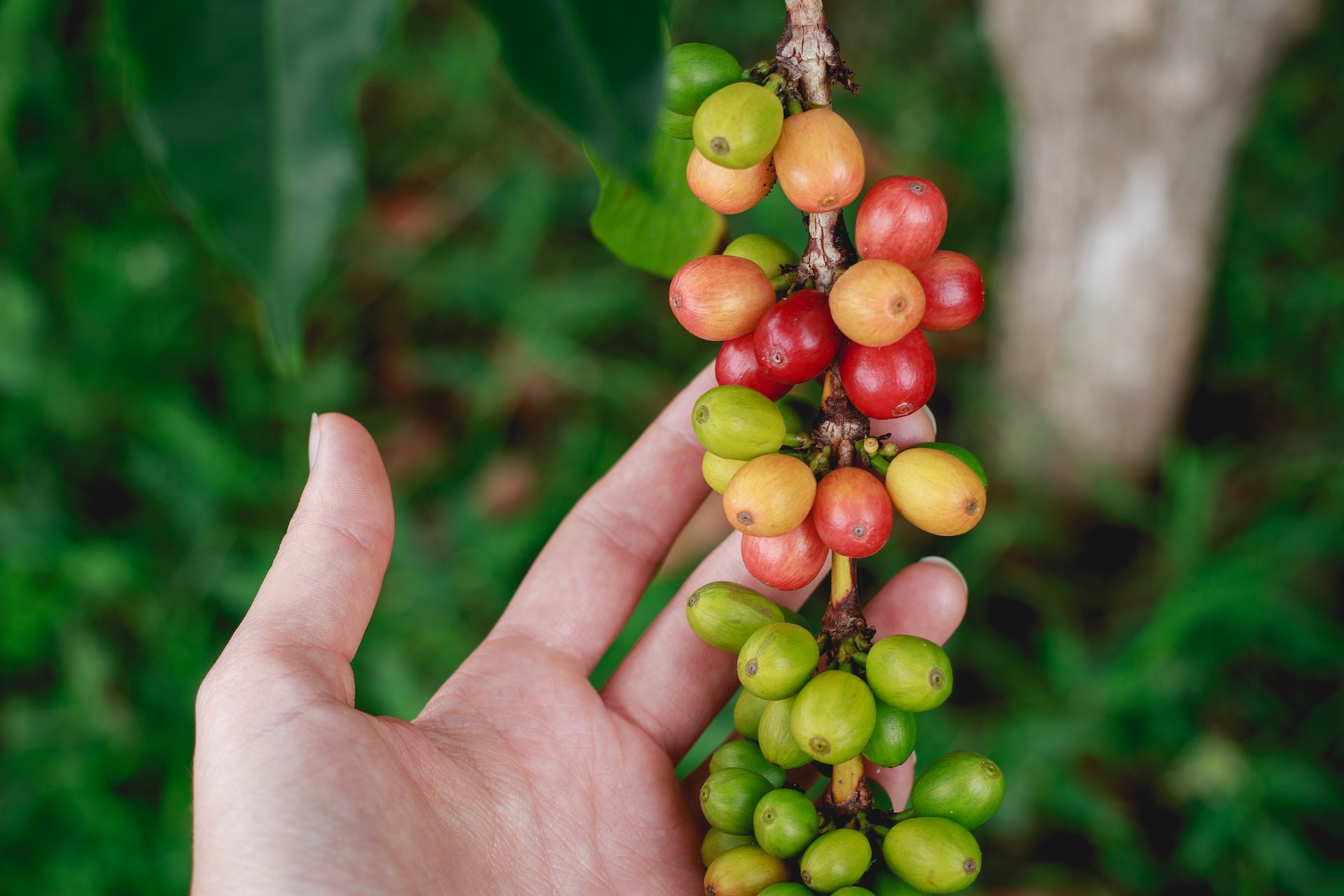
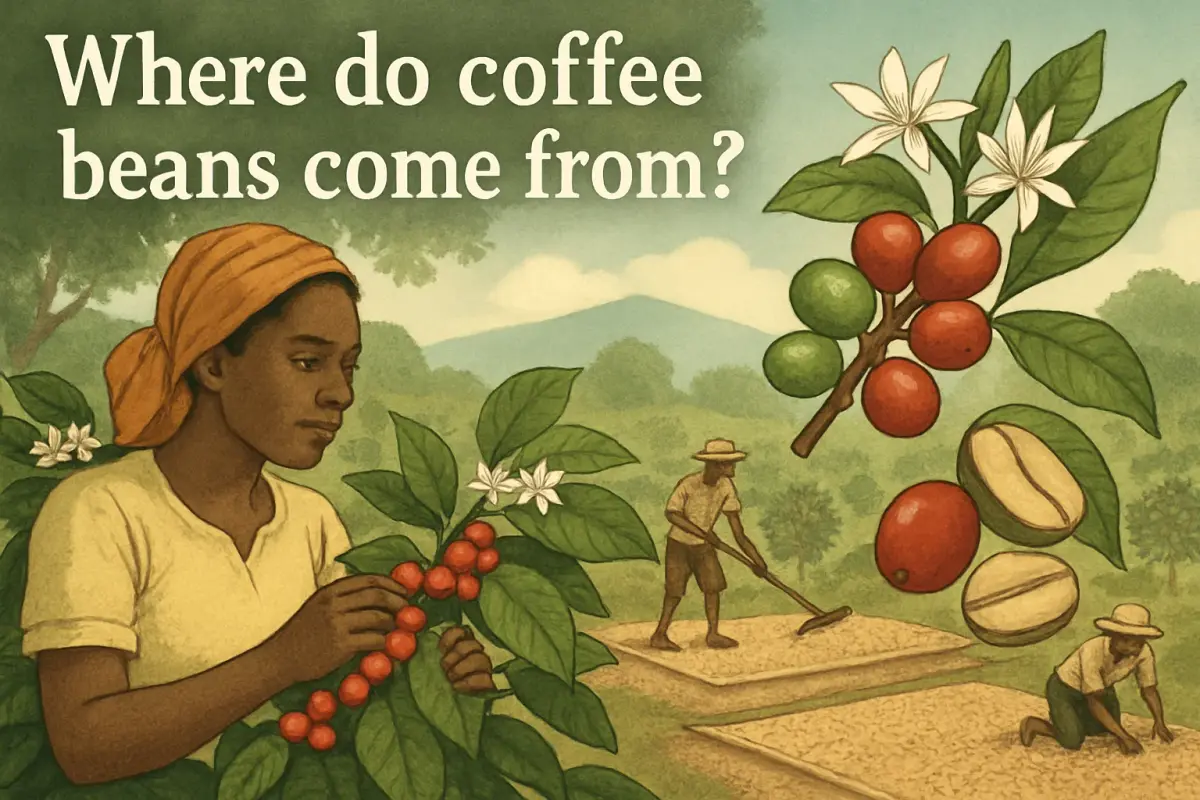
Coffee beans come from the seeds of a fruit called a coffee cherry. The cherries grow on small evergreen trees and shrubs in tropical regions of Africa, Central America, South America, and Asia. After farmers pick and process the cherries, the seeds are dried, exported, roasted, and ground for brewing.

Quick answer: Coffee beans come from the seeds inside coffee cherries. The plants grow mainly in the tropical “Coffee Belt,” which circles the globe between the Tropic of Cancer and the Tropic of Capricorn. Brazil, Vietnam, Colombia, Indonesia, Ethiopia, Honduras, and Uganda are among the leading coffee-producing countries.
What Is a Coffee Bean?
A coffee bean is the seed of a coffee fruit. Botanically, it is not a true bean. It is more like a pit inside a cherry.
A coffee cherry usually contains two flat-sided seeds. These seeds press against each other as they grow. A small number of cherries contain only one round seed. This single seed is called a peaberry.
The main parts of a coffee cherry are:
- Skin: The outer layer of the fruit.
- Pulp: The soft fruit beneath the skin.
- Mucilage: A sticky, sweet layer around the seed.
- Parchment: A thin, protective shell.
- Silver skin: A fine layer that remains close to the seed.
- Seed: The part that becomes the green coffee bean.
Farmers remove the fruit layers through processing. The remaining seed is called green coffee until it is roasted. Heat then changes its color, aroma, size, and flavor.
Coffee plants belong to the Coffea genus. The two species most often used in commercial coffee are Coffea arabica, known as Arabica, and Coffea canephora, commonly called Robusta.
Where in the World Does Coffee Grow?
Coffee grows in a tropical area often called the Coffee Belt. This region lies roughly between 25 degrees north and 30 degrees south of the equator.
The Coffee Belt includes parts of:
- South America
- Central America
- The Caribbean
- Africa
- South Asia
- Southeast Asia
- The Pacific Islands
Coffee needs more than a warm climate. The best growing conditions depend on the plant variety, elevation, rainfall, soil, shade, and local farming methods.
Arabica often grows well in cooler mountain areas. Robusta can tolerate hotter conditions and lower elevations. This difference helps explain why some countries produce mostly Arabica while others grow large amounts of Robusta.
Leading coffee-producing countries
Brazil has been the world’s largest coffee producer for many years. It grows both Arabica and Robusta, which is also known in Brazil as Conilon.
Vietnam is a major producer of Robusta coffee. Its coffee farms are especially important to the global supply of beans used in instant coffee and espresso blends.
Colombia is widely known for Arabica coffee. Its mountain regions, varied climate, and long harvest period support a large coffee industry.
Other major coffee-producing countries include:
| Country or region | Common coffee types | General origin traits |
|---|---|---|
| Brazil | Arabica and Robusta | Large farms, varied terrain, nutty and chocolate-like profiles |
| Vietnam | Mostly Robusta | Full body, strong flavor, often used in blends |
| Colombia | Mostly Arabica | Mountain-grown coffee with bright, balanced flavors |
| Indonesia | Arabica and Robusta | Heavy body, earthy notes, distinctive wet-hulled coffees |
| Ethiopia | Arabica | Floral, fruity, and tea-like profiles are common |
| Honduras | Arabica | Sweet, balanced coffees from highland farms |
| Uganda | Robusta and Arabica | Important Robusta producer with growing specialty Arabica output |
| Peru | Arabica | High-elevation coffees with mild, sweet profiles |
| India | Arabica and Robusta | Coffees often grown under shade, with moderate body |
| Mexico | Arabica | Bright and mild coffees from mountain regions |
These descriptions are broad. Coffee flavor can vary greatly within a single country. A coffee from one farm may taste very different from another coffee grown nearby.

Where Did Coffee Originate?
Coffee plants are native to Africa, especially the highland forests of Ethiopia. Ethiopia is widely recognized as the genetic home of Arabica coffee.
Coffee’s early history is not fully documented. Many popular stories describe a goat herder who noticed that his goats became lively after eating coffee cherries. That story is part of coffee folklore, but it is not firm historical proof.
The use of coffee as a brewed drink developed later in Yemen. By the 15th century, coffee was being cultivated and traded in Yemen. From there, coffee spread through the Middle East, North Africa, Europe, and other parts of the world.
The key distinction is simple:
- Ethiopia is the native home of Arabica coffee plants.
- Yemen played a major role in the early cultivation and trade of coffee as a beverage.
- Modern coffee production now spans many tropical countries.
Coffee cultivation expanded through trade and colonial agriculture. Plants were carried to regions in Asia, the Caribbean, and the Americas. Over time, local climates and farming systems shaped the distinct coffee regions known today.
The history of coffee also includes forced labor, colonial exploitation, and unequal trade systems. A complete account of coffee origins should recognize that coffee became a global crop through both cultural exchange and difficult labor histories.
How Are Coffee Beans Produced?
Coffee production begins with a tree or shrub, but it takes many steps to turn a coffee cherry into a roasted bean.
1. Coffee plants flower
Coffee plants produce small white flowers that often smell sweet. After pollination, the flowers develop into green coffee cherries.
The fruit does not ripen at once. A plant may have flowers, green cherries, and ripe red or yellow cherries at the same time. This uneven ripening makes harvesting more complex.
2. Cherries ripen
Most ripe coffee cherries are red, but some varieties turn yellow, orange, or deep purple. Farmers look for mature fruit because unripe or overripe cherries can affect quality.
Coffee plants may take several years to produce a full crop. Once mature, a plant can produce fruit for many years when it receives proper care.
3. Farmers harvest the fruit
Coffee cherries may be harvested by hand or machine.
Hand picking allows workers to select ripe cherries. This method is common on steep mountain farms and in specialty coffee production. It can improve consistency, but it requires more labor.
Mechanical harvesting is faster and works well on flatter farms. Machines may remove ripe and unripe fruit together, so the crop may need more sorting.
4. Producers process the cherries
The three main coffee processing methods are washed, natural, and honey.
Washed processing
Washed coffee has most of the fruit removed before the seeds dry. Producers usually remove the skin and pulp, allow the mucilage to break down, wash the seeds, and then dry them.
This method often produces a clean, bright cup. It also uses water, so water management matters.
Natural processing
In natural processing, whole cherries dry before the fruit is removed. The seeds remain in contact with the fruit for a longer time.
Natural coffees may have strong fruit notes and a heavier body. Drying must be carefully managed to reduce the risk of mold or uneven fermentation.
Honey processing
Honey processing removes the skin but leaves some mucilage on the seed during drying. The name does not mean that producers add honey.
Honey-processed coffee can show a balance between the clean character of washed coffee and the fruit notes of natural coffee. Results vary based on how much mucilage remains and how the coffee dries.
5. The seeds are dried and prepared for export
After processing, the seeds are dried until they reach a stable moisture level suitable for storage and transport. Producers then remove the parchment and sort the green coffee.
Coffee may be graded by size, density, defects, altitude, variety, processing method, and cup quality. Grading terms are not identical in every country, so a label such as “premium” does not have one universal meaning.
6. Roasters roast the green coffee
Green coffee has a grassy smell and is hard to grind. Roasting causes chemical changes that create the familiar aromas and flavors of coffee.
Roast level is usually described as:
- Light roast: Often preserves more origin character and acidity.
- Medium roast: May balance sweetness, body, and acidity.
- Dark roast: Often has deeper roasted, smoky, or bitter notes.
Roast level does not tell you everything about quality. A coffee’s variety, farm, processing method, freshness, and roast profile also matter.
7. The roasted beans are ground and brewed
After roasting, coffee beans are ground for a brewing method. The grind size, water temperature, contact time, and coffee-to-water ratio all affect the final cup.
This means the place where coffee grows is only one part of the flavor story. Processing and roasting can change how a coffee expresses its origin.

What Is the Difference Between Arabica and Robusta?
Arabica and Robusta are the two main types of coffee used around the world. They differ in plant biology, growing conditions, flavor, caffeine, and common uses.
| Feature | Arabica | Robusta |
|---|---|---|
| Scientific name | Coffea arabica | Coffea canephora |
| Typical growing areas | Higher, cooler regions | Warmer, lower regions |
| Flavor tendency | Sweet, floral, fruity, or bright | Strong, earthy, woody, or nutty |
| Caffeine | Usually lower than Robusta | Usually higher than Arabica |
| Plant resilience | More sensitive to disease and climate stress | Generally more resilient |
| Common uses | Single-origin coffee and specialty coffee | Espresso blends and instant coffee |
These are general patterns, not strict rules. A carefully produced Robusta can taste clean and complex, while a poorly grown Arabica may taste flat or harsh.
Arabica has a narrower range of growing conditions and is more vulnerable to some pests, diseases, and weather problems. Robusta’s stronger plant structure helps it grow in areas that may be too hot or difficult for many Arabica varieties.
Climate change adds pressure to both types. Changes in temperature, rainfall, pests, and disease can affect where coffee can be grown and how much farmers can produce. The exact effect varies by region and farming system.
Does Coffee Grow in the United States?
Coffee does grow in the United States, but the country produces only a small share of the coffee consumed by U.S. drinkers.
The best-known U.S. coffee-growing region is Hawaii. Kona coffee, grown on Hawaii Island, is one of the country’s most recognized coffee origins. Other Hawaiian areas also grow coffee.
Coffee is also grown in Puerto Rico, a U.S. territory. Puerto Rico has a long coffee-growing tradition, although hurricanes, disease, labor challenges, and other disruptions have affected production over time.
Most coffee sold in the United States comes from overseas because coffee plants need tropical or subtropical growing conditions. The continental United States does not have enough suitable land and climate to supply the national market at its current scale.
When a package says “roasted in the USA,” that usually describes where roasting took place. It does not mean the coffee beans were grown in the United States.
Look for wording such as:
- Grown in: The country or region where the coffee plant was cultivated.
- Origin: The farm, cooperative, region, or country connected to the green coffee.
- Roasted in: The location where the beans were heated.
- Blend: Coffee made from beans from two or more origins.
These terms help separate the bean’s growing location from the place where it was processed or roasted.

How Does Coffee Origin Affect Flavor?
Coffee origin can influence flavor because climate, altitude, soil, coffee variety, and farm practices affect the fruit and seed. However, origin is not a flavor guarantee.
For example, high-elevation Arabica coffees may show bright acidity, floral aromas, or fruit notes. Coffees from lower elevations may have heavier body or more earthy flavors. These patterns are useful clues, but they do not apply to every farm.
Processing also has a major effect. A naturally processed coffee may taste fruitier than a washed coffee from the same area. Roast level can then make those differences more or less noticeable.
Use origin labels as a starting point:
- Choose Ethiopian coffee if you often enjoy floral or fruit-like flavors.
- Choose Brazilian coffee if you prefer smooth, nutty, or chocolate-like notes.
- Choose Colombian coffee if you want a balanced coffee with noticeable brightness.
- Choose Sumatran or other Indonesian coffee if you like earthy flavors and a heavy body.
- Choose Vietnamese Robusta if you prefer a strong, intense cup or want a bold espresso blend.
These are broad starting points, not guarantees. The roast date, freshness, brewing method, and recipe may matter just as much as the country name.

Common Misunderstandings About Coffee Origins
Coffee beans do not grow inside a coffee plant’s beans
The “bean” is a seed inside the coffee cherry. The fruit grows on the plant, and the seed is removed during processing.
Dark roast does not mean the coffee came from a certain country
Dark roasting can produce similar smoky or bitter notes in beans from many regions. Roast level describes how the beans were roasted, not where they grew.
“100% Arabica” does not identify the origin
Arabica describes the coffee species or type. A bag labeled 100% Arabica may contain beans from one country or several countries.
A country label may not name one farm
“Colombia,” “Brazil,” or “Ethiopia” may describe a national origin. A more detailed label may name a region, cooperative, estate, or farm.
Single-origin does not always mean single farm
The term often means the coffee comes from one country or defined area. The exact meaning depends on the seller’s labeling practice.
Specialty coffee is not the same as coffee from one country
“Specialty coffee” generally refers to quality and evaluation standards, while origin describes where the coffee came from. A coffee can be both single-origin and specialty, but the terms describe different things.
Key takeaways
- Coffee beans are seeds inside coffee cherries.
- The plants grow mainly in the tropical Coffee Belt.
- Ethiopia is the native home of Arabica coffee.
- Brazil is the largest coffee-producing country in many recent production reports.
- Arabica and Robusta are the two main commercial coffee types.
- The United States grows coffee mainly in Hawaii and Puerto Rico, but imports most of the coffee it consumes.
- Origin affects flavor, but processing, roasting, freshness, and brewing matter too.
Frequently Asked Questions
Are coffee beans fruits or seeds?
Coffee beans are seeds. They grow inside fruits called coffee cherries.
What country produces the most coffee?
Brazil has been the leading coffee-producing country in recent global production reports. Its farms produce both Arabica and Robusta.
Is coffee native to South America?
No. Coffee is native to Africa, with Ethiopia recognized as the home of Arabica coffee. Coffee later spread to South America through trade and cultivation.
Why is Ethiopian coffee often described as fruity?
Many Ethiopian Arabica coffees grow in highland areas and may use processing methods that highlight floral or fruit-like notes. These flavors are not present in every Ethiopian coffee.
Can coffee beans grow in California or Florida?
Small-scale coffee growing may be possible in limited warm areas, but the continental United States does not produce coffee at the scale needed for national demand. Hawaii and Puerto Rico are the best-known U.S. coffee-growing locations.
Does where coffee is grown matter more than how it is roasted?
Neither factor always matters more. Origin shapes the potential flavor, while processing, roasting, freshness, grinding, and brewing determine how much of that character appears in the cup.
Sources and Further Reading
For reliable background on coffee origins and production, consult:
- International Coffee Organization: Coffee Trade Statistics
- U.S. Department of Agriculture Foreign Agricultural Service
- U.S. Department of Agriculture National Agricultural Statistics Service
- World Coffee Research: Coffee Varieties and Research
- Royal Botanic Gardens, Kew: Plants of the World Online
Conclusion
Coffee beans come from the seeds of coffee cherries grown on tropical plants. Most commercial coffee comes from the Coffee Belt, with Brazil, Vietnam, Colombia, Ethiopia, Indonesia, Honduras, and other countries supplying the global market.
To understand a coffee’s origin, check more than the country name. Look for the species, region, processing method, roast date, and whether the package describes the coffee as a single origin or blend. Then match those details to the flavors you enjoy and the way you brew at home.