
Introduction
Coffee grinding is the process of breaking roasted coffee beans into smaller pieces before brewing. In the United States, it is a key step in making drip coffee, pour-over, French press, espresso, and cold brew at home or in cafés. The size and shape of those pieces affect how fast water moves through the coffee and how much flavor it extracts.
A good grind does not need to be expensive or complex. It needs to match the brewing method, the coffee, and the time that water touches the grounds. This guide explains what coffee grinding is, why it matters, which grind size to use, and how to fix common problems.
What Is Coffee Grinding?
Coffee grinding turns whole roasted beans into grounds that water can pass through. Grinding increases the bean’s surface area. This lets water dissolve flavor compounds from the roasted coffee.
Whole beans are too large for most brewing methods. Water would touch only a small part of each bean. Ground coffee gives water many more surfaces to reach.
The goal is not to make coffee as fine as possible. The goal is to create particles that suit the brewing method.
Why grind size changes coffee flavor
Grind size affects three main parts of brewing:
- Extraction speed: Fine grounds release flavor faster.
- Water flow: Coarse grounds leave larger spaces between particles.
- Contact time: Water may touch the coffee for seconds or several minutes.
If coffee extracts too little flavor, it may taste sour, sharp, thin, or salty. If it extracts too much, it may taste bitter, dry, harsh, or hollow.
These flavors also depend on water temperature, brewing time, coffee dose, roast level, and bean type. Grind size is important, but it is not the only variable.
What does “extraction” mean?
Extraction is the movement of soluble compounds from coffee grounds into water. Some compounds dissolve early, while others dissolve later.
A balanced cup usually has enough sweetness, aroma, body, and acidity. The best balance depends on personal taste. One person may prefer a bright and light cup, while another may prefer a deep and heavy cup.
The Specialty Coffee Association describes brewing as a process shaped by variables such as grind size, water, time, temperature, and coffee-to-water ratio. These variables work together, so changing one can change the result of the whole brew.
Why Does Coffee Grind Size Matter?
Coffee grind size matters because it controls how easily water moves through the grounds. It also changes how quickly water extracts flavor.
A finer grind has smaller particles and more total surface area. Water can extract flavor from it quickly. A coarser grind has larger particles and usually allows water to pass with less resistance.
Fine grind
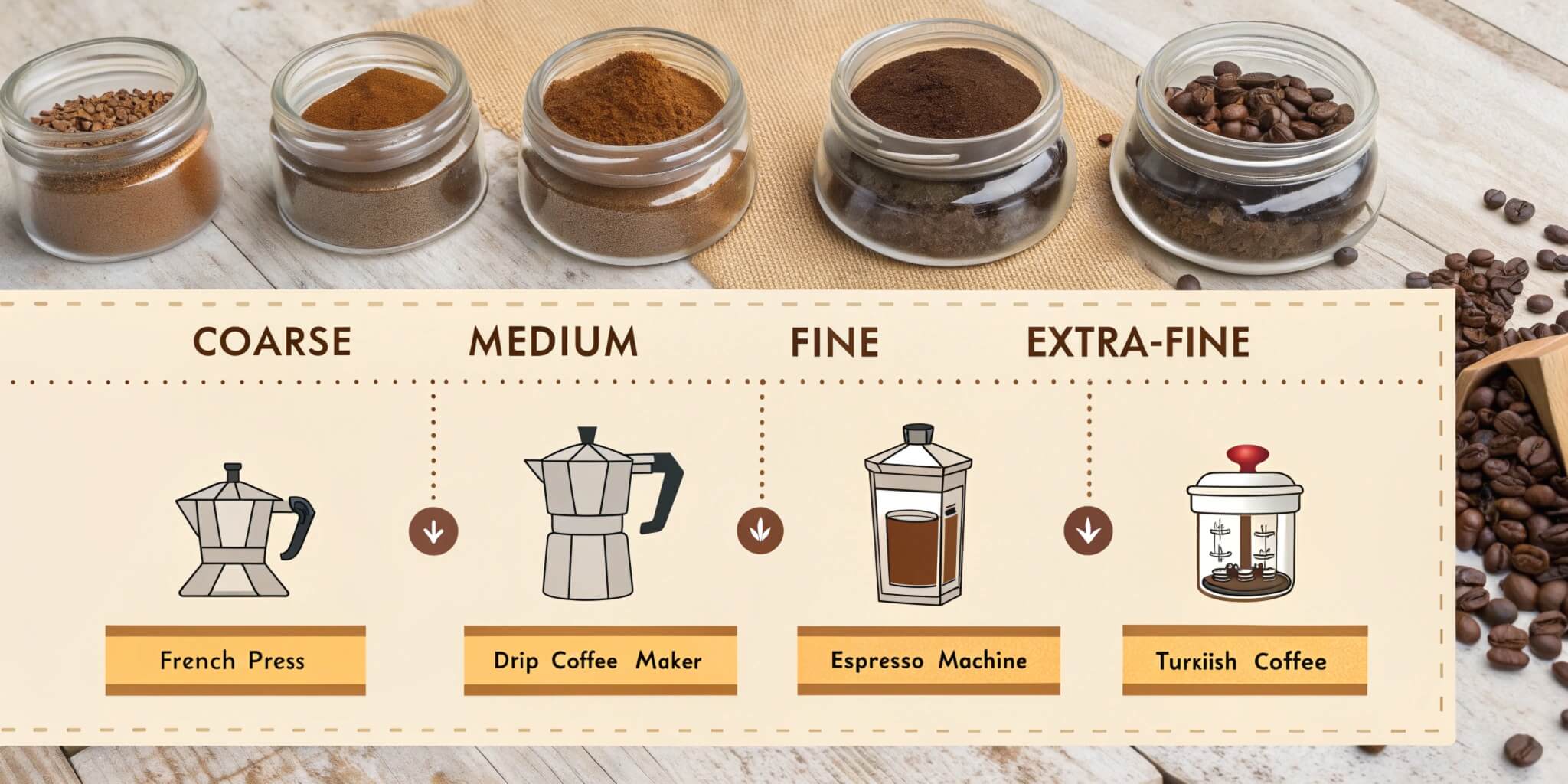
Fine coffee grounds feel close to table salt or flour, depending on the setting. They suit fast brewing methods that use pressure or short contact time.
Common uses include:
- Espresso
- Moka pot, depending on the brewer
- Turkish coffee, which uses an extremely fine grind
Fine grounds can block water flow in some brewers. They may also create a bitter or dry cup if the brew runs too long.
Medium grind
medium grounds are common for automatic drip machines and many pour-over brewers. They often look similar to regular sand.
Medium grinds allow water to flow at a moderate speed. They are a useful starting point for flat-bottom drip brewers and some cone-shaped pour-over devices.
Coarse grind
Coarse grounds have larger pieces. They suit methods with longer contact times.
Common uses include:
- French press
- Cold brew
- Some percolators
Coarse grounds can reduce sediment in a French press. However, an overly coarse grind may produce weak or sour coffee because water cannot reach enough of the coffee’s soluble material.
Grind size is not the same as coffee strength
Strength means how much dissolved coffee material is in the finished drink. Grind size affects extraction, not strength by itself.
To make coffee stronger, you can often use more coffee or less water. To correct sour or bitter flavor, you may need to change grind size, time, temperature, or another brewing factor.
For example, adding more coffee to an under-extracted brew may make it stronger but still sour. The brew may need a finer grind or a longer contact time.
Coffee Grind Size Chart by Brewing Method
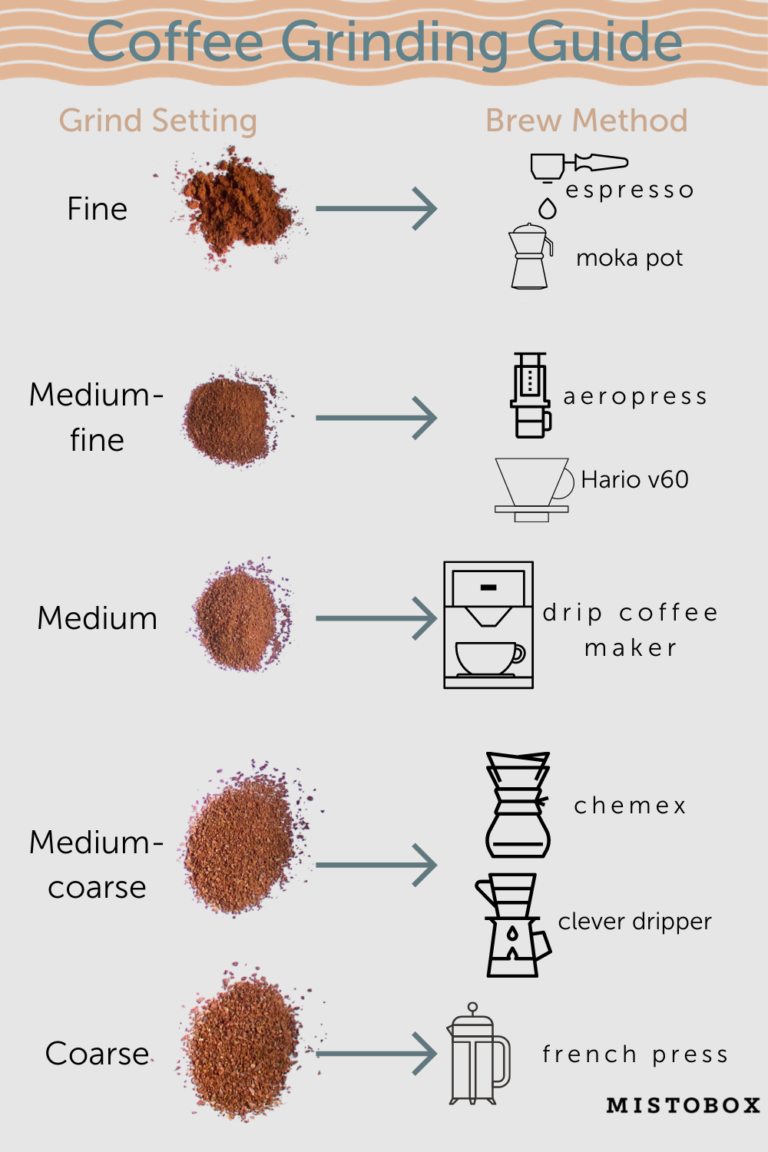
The table below gives useful starting points. Grinder markings differ, so treat these terms as guides rather than fixed measurements.
| Brewing method | Starting grind | Why it works |
|---|---|---|
| Turkish coffee | Extra fine | The grounds remain in the cup and need to be very small |
| Espresso | Fine | Pressure moves water through coffee quickly |
| Moka pot | Fine to medium-fine | Short brewing time and strong water flow need smaller grounds |
| AeroPress | Fine to medium | The best setting depends on recipe and steep time |
| Automatic drip | Medium | Supports moderate flow and contact time |
| Pour-over | Medium to medium-fine | Helps control flow through the filter |
| Chemex | Medium-coarse | A thick paper filter and longer brew often suit larger grounds |
| French press | Coarse | Long steeping time and a metal filter work well with larger particles |
| Cold brew | Coarse | Long steeping time calls for slower extraction |
Start with the suggested setting for your method. Then adjust one step at a time.
A finer grind usually slows water flow and increases extraction. A coarser grind usually speeds water flow and reduces extraction. The right change depends on the taste and the brew time.
Burr Grinder vs. Blade Grinder
A burr grinder crushes coffee between two abrasive surfaces called burrs. A blade grinder chops beans with a spinning blade.
Burr grinders
Burr grinders usually produce a more even particle size. This helps water contact the coffee more evenly.
Common burr grinder types include:
- Conical burr grinders: Often compact and practical for home use.
- Flat burr grinders: Common in commercial settings and some home machines.
- Manual burr grinders: Use a hand crank and need no electricity.
Burr grinders can cost more than blade grinders. They also need cleaning and may produce some fine dust. Still, their control and consistency make them a strong choice for people who change brewing methods or care about repeatable results.
Blade grinders
Blade grinders are often less expensive and easy to find. They do not offer a true grind setting. Instead, the user controls particle size by running the blade for more or less time.
A short pulse may leave large chunks. A long run may create a mix of fine powder and larger pieces. This uneven mix can lead to both over-extracted and under-extracted flavors in the same cup.
If you use a blade grinder:
- Add the same amount of coffee each time.
- Use short pulses instead of one long run.
- Shake the grinder gently between pulses.
- Stop when the grounds look as even as possible.
- Brew soon after grinding.
A blade grinder can make drinkable coffee. A burr grinder usually makes it easier to control the result.
How to Choose the Right Coffee Grind
Choose a grind by starting with the brewing method, then adjust it based on taste and flow.
Step 1: Match the grind to the brewer
Use a fine grind for fast methods, a medium grind for many drip methods, and a coarse grind for long steeping methods.
This is a starting point, not a rule. Each grinder uses its own scale. A “6” on one grinder may be finer or coarser than a “6” on another.
Step 2: Keep other variables steady
When dialing in coffee, change one variable at a time. Keep the coffee dose, water amount, water temperature, and recipe steady.
This makes it easier to see what the grind changed.
Step 3: Taste the coffee
Use taste as the main guide.
- If the coffee tastes sour, sharp, or thin, try a slightly finer grind.
- If the coffee tastes bitter, dry, or harsh, try a slightly coarser grind.
- If the coffee tastes weak but not sour, use more coffee or less water.
- If the coffee tastes strong but unpleasant, adjust extraction before changing the dose.
These are starting suggestions. Dark roasts, light roasts, fresh coffee, and stale coffee may need different settings.
Step 4: Watch the brew time
Brew time can help explain the taste.
A very fast brew with sour flavor may need a finer grind. A very slow brew with bitter flavor may need a coarser grind. However, brew time varies by method, filter, pour pattern, and equipment.
Do not chase a single time number if the coffee tastes good. Taste matters more than a fixed target.
Step 5: Make small changes
Move the grinder one or two steps at a time. Large changes make it hard to know what solved the problem.
Keep a short record of:
- Coffee name and roast date
- Grind setting
- Coffee dose
- Water amount
- Brew time
- Taste
This simple log can help you repeat a good cup.
How Freshly Ground Coffee Affects Flavor
Fresh grinding usually helps preserve coffee aroma. Once beans are ground, much more surface area is exposed to air. Aroma compounds can leave the grounds faster than they leave whole beans.
Whole beans also release carbon dioxide after roasting. This process is called degassing. Coffee that is extremely fresh may release a lot of gas during brewing, which can affect how water moves through the grounds.
For many coffees, grinding just before brewing gives the strongest aroma. Ground coffee can still be useful, especially when convenience matters. Store it in an airtight container away from heat, moisture, light, and strong odors.
Avoid storing coffee in the refrigerator unless you can prevent moisture and odor transfer. Moving cold coffee in and out of the refrigerator can create condensation.
Do you need to grind coffee immediately before brewing?
No. Grinding just before brewing is helpful, but it is not a requirement.
Pre-ground coffee may be a good choice when:
- You do not own a grinder.
- You need a fast morning routine.
- You are traveling.
- You use coffee before it becomes noticeably stale.
The practical difference depends on the coffee’s packaging, storage, age, and your taste. Fresh grinding gives more control, but a good brew method can still improve pre-ground coffee.
Common Coffee Grinding Problems and Fixes
Most grind problems show up as a taste or flow issue. Use the symptom first, then check the likely causes.
Coffee tastes sour or sharp
Possible causes include:
- Grind is too coarse.
- Brew time is too short.
- Water is too cool.
- Coffee dose is too low.
- The coffee itself has a naturally bright flavor.
Try a slightly finer grind first. If the brew becomes slow but still tastes sour, check the water temperature, recipe, and coffee freshness.
Coffee tastes bitter or dry
Possible causes include:
- Grind is too fine.
- Brew time is too long.
- Water is too hot.
- Too much coffee was extracted.
- The coffee is very dark roasted.
Try a slightly coarser grind. Also check whether the filter is blocked or the brewer is draining too slowly.
Coffee tastes weak
Weak coffee may result from too little coffee, too much water, a coarse grind, or under-extraction.
If the flavor is weak but balanced, increase the coffee dose or reduce the water. If it is weak and sour, try a finer grind or a longer brew.
The filter clogs
A filter may clog when the grind is too fine or when the grinder creates too much fine dust. This can happen with some blade grinders and certain burr settings.
Try a coarser setting. Pour more gently in a pour-over brewer. Clean the grinder and check that the filter is seated correctly.
The grind looks uneven
Uneven grounds often come from a blade grinder, worn burrs, inconsistent beans, or poor grinder alignment.
Short pulses can improve blade-grinder results. If the problem continues, a burr grinder may provide better control.
The coffee tastes different each day
Inconsistent results can come from changing the dose, water level, grind setting, pour speed, or coffee storage.
Use a digital scale if possible. Weigh the coffee and water, and write down the grinder setting. Consistency makes troubleshooting much easier.
How to Grind Coffee More Consistently
Consistent grinding starts with a repeatable process.
- Measure the beans. Use the same amount for each brew.
- Use the same grinder setting. Record changes.
- Grind only what you need. This limits waste and helps freshness.
- Check the grounds. Look for large chunks or excessive powder.
- Clean the grinder often. Old coffee oils and particles can affect flavor.
- Change one variable at a time. This shows what caused the improvement.
Do not wash an electric grinder unless the manufacturer says that water is safe. Unplug the grinder before cleaning it. Use the owner’s manual for burr removal, brush use, and replacement parts.
Coffee grinders contain moving parts and sharp burrs. Keep fingers, clothing, and loose objects away from the grinding chamber. Children should not operate a grinder without suitable supervision.
Coffee Grinding Mistakes to Avoid
Using the same grind for every brewer
Espresso, drip coffee, French press, and cold brew use different contact times and filter systems. One grind setting cannot work equally well for all of them.
Changing several variables at once
Changing grind size, dose, water temperature, and brew time together hides the cause of the result. Make one small change, then taste again.
Assuming finer always means stronger
A finer grind can increase extraction, but it may also cause bitterness or slow flow. Strength depends mainly on the amount of coffee material in the drink.
Ignoring coffee age
Old coffee may taste flat even when the grind is correct. Very fresh coffee may behave differently as it releases gas.
Trusting the grinder number
Grinder numbers are not universal. Use taste, flow, and particle appearance as better guides than the number alone.
Grinding too far ahead
Pre-ground coffee loses aroma faster than whole beans. Grind close to brewing when practical, and store unused grounds in an airtight container.
Key Takeaways
- Coffee grinding breaks roasted beans into smaller pieces for brewing.
- Grind size controls water flow and extraction speed.
- Fine grounds suit fast brewing methods such as espresso.
- Medium grounds suit many drip and pour-over brewers.
- Coarse grounds suit French press and cold brew.
- A burr grinder usually creates more even grounds than a blade grinder.
- Sour coffee often needs a finer grind or more extraction.
- Bitter coffee often needs a coarser grind or less extraction.
- Change one brewing variable at a time.
- Fresh grinding improves aroma, but pre-ground coffee can still brew well.
Frequently Asked Questions
What is the best grind size for coffee?
There is no single best grind size for every coffee. Use fine grounds for espresso, medium grounds for many drip brewers, and coarse grounds for French press and cold brew. Then adjust the setting based on taste and brew flow.
Is ground coffee the same as coffee powder?
Not always. Coffee grounds are particles made for brewing. Coffee powder usually means much finer particles, such as those used for Turkish coffee or instant coffee production. The terms can vary by region and product label.
Can I use espresso grind in a drip coffee maker?
You can, but it may slow the flow or clog the filter. The result may taste bitter or dry. A medium grind is usually a better starting point for automatic drip coffee.
Can I use coarse coffee in an espresso machine?
Coarse grounds usually allow water to pass too quickly through an espresso puck. The espresso may taste thin, sour, or weak. Espresso machines normally need a fine grind, though the exact setting depends on the machine and coffee.
Should I grind coffee finer or coarser for cold brew?
Start with a coarse grind. Cold brew uses a long steeping time, so very fine grounds can create bitter flavor and excess sediment. Adjust slightly finer only if the drink tastes weak and under-extracted.
Does grinding coffee make it stronger?
Grinding does not automatically make coffee stronger. A finer grind can increase extraction, but drink strength also depends on the coffee-to-water ratio. Use more coffee for a stronger drink, then adjust the grind to improve flavor.
Conclusion
Coffee grinding is the controlled breaking of roasted beans into particles that match a brewing method. The right grind helps water move at a useful speed and extract a balanced amount of flavor.
Start with the method’s usual grind range. Keep the recipe steady. Adjust one step at a time based on taste, flow, and brew time. With that simple approach, you can improve coffee from almost any home brewer without relying on guesswork.



One Comment