You can grind coffee beans without a grinder by using a rolling pin, mortar and pestle, food processor, blender, or a heavy pan. The best method depends on the tools in your U.S. kitchen and the grind size your coffee maker needs. For the most even result, use a mortar and pestle or rolling pin and work in small batches.
Grinding by hand takes more time than using a burr grinder. It can still make a good cup of coffee when you use steady pressure, stop often, and remove large pieces before brewing.

The Best Ways to Grind Coffee Beans Without a Grinder
The rolling pin and mortar-and-pestle methods give you the most control. A blender or food processor is faster, but it may leave a mix of fine powder and large pieces.
| Method | Best for | Main benefit | Main drawback |
|---|---|---|---|
| Mortar and pestle | Coarse to medium grinds | Good control | Small batches |
| Rolling pin | Medium to coarse grinds | Simple and low cost | Takes some effort |
| Food processor | Larger batches | Fast | Uneven grind |
| Blender | Small emergency batches | Common in many homes | Can heat beans and create powder |
| Heavy pan | Coarse grind | No special tool needed | Hard to control |
| Knife | Very small emergency batch | Requires little equipment | Least even and least safe |
Coffee beans are dense and brittle. Crushing them first is usually easier than trying to cut them into neat pieces. Aim for particles that are close in size, since very fine pieces extract faster than large pieces.
1. Mortar and pestle
A mortar and pestle is the best hand method for control. It lets you crush the beans, then grind them to the size you need.
- Add a small amount of beans to the mortar. Start with about 1 to 2 tablespoons.
- Press down with the pestle to crack the beans.
- Grind in a circular motion.
- Shake the mortar gently to bring larger pieces to the top.
- Keep grinding until the pieces look close in size.
- Transfer the grounds to a bowl and repeat if needed.
Use a light touch at first. Hard, fast pounding can send beans out of the bowl and may damage a ceramic mortar.
This method works well for French press and pour-over coffee. It is less practical for a large drip batch because you may need several rounds.
2. Rolling pin
A rolling pin can produce a useful medium or coarse grind with a little patience.
- Place the beans in a thick, food-safe zip-top bag.
- Press out most of the air and seal the bag.
- Lay the bag flat on a sturdy counter.
- Cover it with a clean kitchen towel if you want to reduce noise and protect the bag.
- Tap the beans gently with the rolling pin to crack them.
- Roll over the pieces until they reach the desired size.
- Tilt the bag and check for whole or large pieces.
Do not use a thin sandwich bag. Coffee beans can pierce it, and the bag may split while you work. A sealed bag also helps keep grounds away from your counter.
The rolling pin is a good choice when you need enough coffee for two to four cups. Work in batches if the bag becomes too full for the beans to spread into one layer.
3. Food processor
A food processor can grind beans quickly, but it will not usually create a uniform grind.
- Add a small batch of beans to the bowl.
- Secure the lid.
- Use short pulses rather than running the motor continuously.
- Shake the bowl between pulses if the appliance instructions allow it.
- Stop when most pieces look close to the size you need.
- Remove very large pieces and pulse them again.
Short pulses help limit heat and prevent the beans from turning into a thick layer of fine dust. Do not fill the bowl to the top. The beans need room to move.
A food processor is most useful for French press, cold brew, or other methods that can tolerate a less even grind. It is less suitable for espresso, which needs a very fine and consistent grind.
4. Blender
A blender works in much the same way as a food processor.
- Add a small amount of beans.
- Use the pulse setting.
- Pulse for one or two seconds at a time.
- Pause and check the texture often.
- Stop before the beans become mostly powder.
Blenders can push beans into a narrow area below the blades. Tilt or shake the container only if the manufacturer permits it and the blades are not moving. Never place a utensil into a running blender.
Clean the blender soon after use. Coffee oils can cling to the container and affect smoothies or other foods.
5. Heavy pan
A heavy skillet or saucepan can crush coffee beans in an emergency.
- Put the beans in a strong zip-top bag or between two sheets of parchment paper.
- Place the package on a stable counter.
- Press down with the flat bottom of the pan.
- Rock the pan over the beans.
- Check the pieces and repeat until they are coarse enough to brew.
This method is slow and gives limited control. It is better for a French press than for a paper-filter brewer.
6. Knife
A chef’s knife can split a few beans, but it is the least useful option. The beans may roll, and the knife can slip.
If you must use a knife, place one bean at a time on a stable cutting board. Lay the flat side of the knife over the bean and press down carefully with your palm. Do not chop rapidly or hold the bean with your fingers.
For most people, a rolling pin or pan is safer and more effective.
How Fine Should Your Coffee Grounds Be?
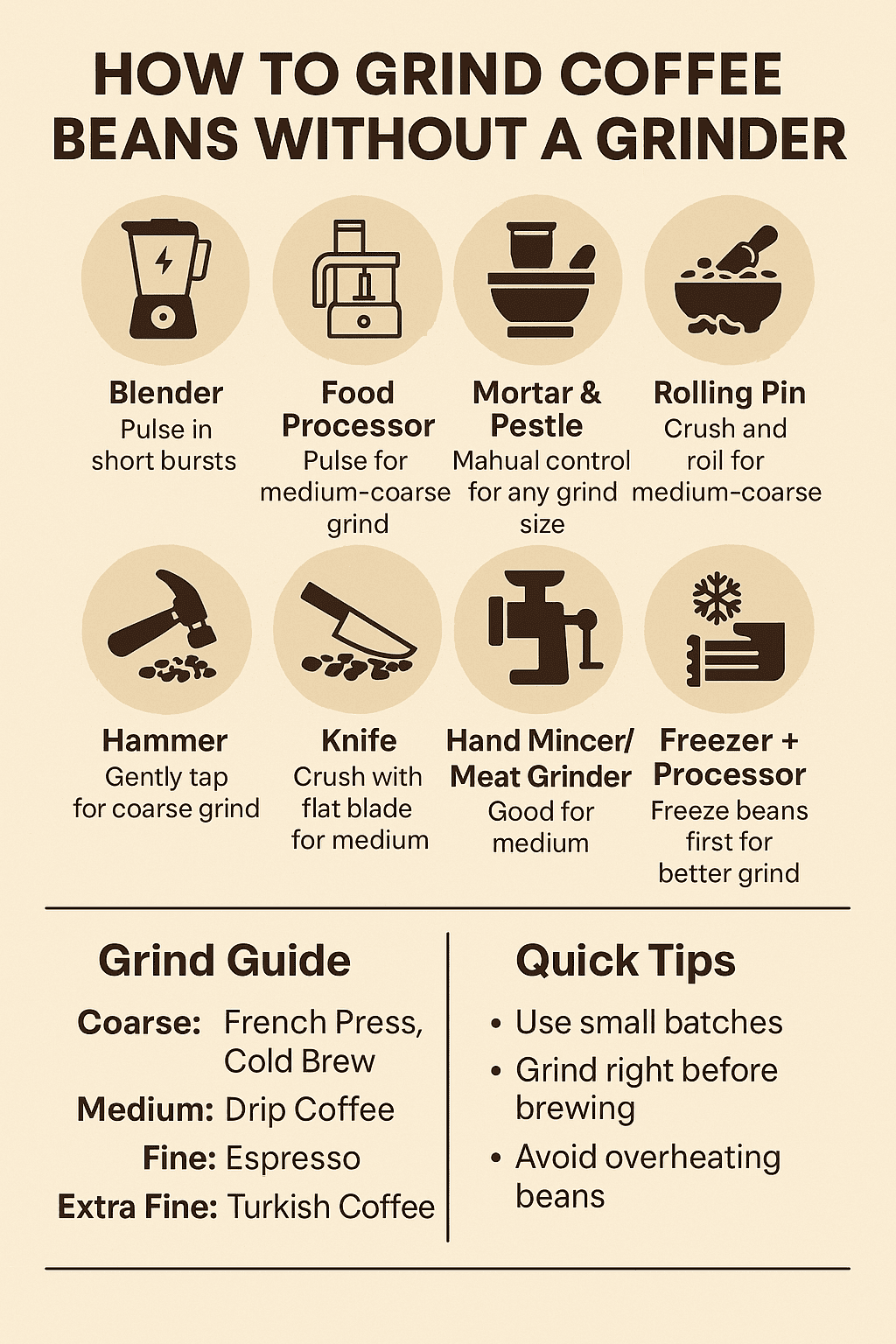
Choose the grind size based on your brewing method. Coarse grounds expose less surface area to water, while fine grounds expose more. That changes how quickly flavor compounds move into the water.
| Brewing method | Target grind without a grinder | What it should look like |
|---|---|---|
| Cold brew | Coarse | Like coarse sea salt |
| French press | Coarse | Large, distinct pieces |
| Percolator | Medium-coarse | Rough sand |
| Drip coffee maker | Medium | Similar to regular sand |
| Pour-over | Medium to medium-fine | Fine sand |
| Moka pot | Fine | A little finer than table salt |
| Espresso | Very fine | Powder-like, but not floury |
These descriptions are practical guides, not exact measurements. Coffee makers vary, and hand-crushed beans will not be perfectly uniform.
Match the grind to the brewing time
Long contact times usually need a coarser grind. French press coffee often sits in water for several minutes, so coarse pieces help reduce over-extraction.
Short contact times need a finer grind. Espresso passes water through coffee quickly, so it requires very fine particles. A blender or rolling pin rarely produces the consistency needed for reliable espresso.
Use the texture as your guide
After grinding, spread the coffee on a plate or piece of parchment paper. Look for large pieces and excess powder.
- Too many large pieces: Grind or crush the batch again.
- Mostly powder: Use less force and shorter pulses next time.
- A mix of sizes: Sift out the largest pieces and rework them.
- A soft, flour-like texture: The coffee may taste bitter or harsh in many brewing methods.
Do not chase perfect uniformity with a hand method. Instead, remove the biggest pieces and avoid creating a large amount of powder.

How Much Coffee Should You Grind?
Use the amount of coffee your recipe calls for, then add a small allowance for loss during crushing and transfer. A common starting point is about 1 to 2 tablespoons of whole beans per 6 fluid ounces of water, but recipes differ.
For a more repeatable result, weigh the beans before grinding. A kitchen scale can help you use the same amount each time. If you do not have a scale, measure whole beans by volume and use the same spoon or scoop for future batches.
Example for a small French press
For a 12-ounce French press:
- Start with about 24 to 30 grams of whole beans.
- Grind them to a coarse texture.
- Add the coffee to the press.
- Use hot water, but avoid a hard boil if possible.
- Brew according to your recipe.
- If the coffee tastes weak, use more coffee or grind slightly finer next time.
- If it tastes bitter or dry, use less coffee or grind slightly coarser.
This is a starting example, not a universal rule. Roast level, bean type, water, and brew time all affect the result.
Grind only what you need
Freshly ground coffee loses aroma faster than whole beans because grinding exposes more surface area to air. Grind the amount you plan to brew rather than preparing a large supply for several days.
If you must store hand-ground coffee, use an airtight container in a cool, dry cabinet. Do not store it in the refrigerator, where moisture and food odors can affect the coffee.

How to Get a More Even Hand Grind
The key to better results is to work in small batches and use more than one pass.
Use a two-stage process
First, crack the beans. Then grind the cracked pieces.
This works better than trying to make a fine grind immediately. Whole beans resist pressure, while cracked beans break down more easily.
Keep the batch shallow
Spread the beans into a single layer when using a bag, pan, blender, or food processor. A deep pile lets some beans escape the pressure and remain whole.
Sort the largest pieces
After grinding, pour the coffee onto a plate. Pick out any pieces that are much larger than the rest. Crush those pieces separately, then mix them back into the batch.
This simple step can improve extraction more than grinding the entire batch longer.
Avoid excess heat
Heat can reduce aroma and create a dull flavor. Hand methods usually produce less heat than running an electric blade for a long time, but continuous blending can still warm the beans.
Use short pulses with electric appliances. Let the beans rest if the container feels warm.
Clean the tool
Coffee contains oils that can affect later foods and drinks. Brush out the mortar, rolling-pin bag, pan, blender, or food processor after use. Wash the tool according to its material and the manufacturer’s instructions.
Do not rinse an electric appliance while it is plugged in or place a motor base in water.

Common Problems and How to Fix Them
The coffee tastes bitter
Bitter coffee often comes from too fine a grind, too much contact time, very hot water, or too much coffee. Hand grinding can create extra-fine powder even when the main pieces look coarse.
Try these changes:
- Use gentler pressure.
- Grind for less time.
- Remove excess powder with a fine sieve.
- Use a coarser grind.
- Reduce the brew time.
The coffee tastes sour or weak
Sour or thin coffee may be under-extracted. This can happen when the pieces are too large or when water moves through the coffee too quickly.
Try grinding slightly finer, using more coffee, or increasing the brew time. Change one factor at a time so you can tell what helped.
The coffee tastes gritty
Grit usually means the grind is too coarse for the filter or brewer. A French press can hold coarse grounds, but a paper-filter setup may allow small pieces through if the batch is uneven.
Use a finer grind for the next batch, or pour the grounds through a paper filter after crushing them.
The bag keeps breaking
Use a thick freezer-style bag and grind less coffee at one time. Remove sharp objects from the work area and do not strike the bag with excessive force.
A mortar and pestle may be a better choice if the bag continues to split.
The beans will not break down
The batch may be too large, or the tool may not provide enough pressure. Reduce the amount and crack the beans first.
Very dark roasted beans may feel more brittle, while some lighter roasted beans can feel dense and hard. Either type can be crushed, but the pressure needed may differ.
The coffee maker clogs
Fine powder can block some filters and create slow drainage. Stop using the finest portion for that brew. A coarse hand grind is usually safer for French press and cold brew, while a medium grind works better for many automatic drip machines.
If the brewer remains blocked, unplug it before cleaning and follow the appliance instructions.

Safety Tips for Grinding Coffee by Hand
Use stable tools and keep your hands away from moving blades. Do not hold beans with your fingers while cutting them, and do not use a glass container that could crack under pressure.
Never place a spoon, knife, or other utensil into a running blender or food processor. Unplug the appliance before removing stuck grounds or cleaning near the blade.
If you use a zip-top bag, check it for holes before and after grinding. Dispose of the bag if it has split or if plastic has entered the coffee.
Keep children away from sharp tools, heavy pans, and running appliances. If a method feels unstable, stop and switch to a rolling pin, mortar and pestle, or another safer option.

Which Method Should You Choose?
Choose the mortar and pestle if you want the most control and only need a small amount. Choose a rolling pin if you want a simple method with common kitchen tools.
Use a food processor or blender when speed matters more than evenness. Use a heavy pan only when you need a coarse grind and have no better tool.
For espresso, do not expect a reliable result from these methods. Espresso needs a very fine and even grind, and a dedicated burr grinder is usually the practical solution. For drip coffee, pour-over, French press, or cold brew, careful hand grinding can work well enough for an emergency cup.

Frequently Asked Questions
Can I grind coffee beans with a regular blender?
Yes. Use short pulses and small batches. A blender may create an uneven mix, so it works best for coarse or medium-coarse coffee rather than espresso.
Can I grind coffee beans in a food processor?
Yes. Pulse the beans instead of running the motor continuously. Shake the batch between pulses only when the appliance instructions allow it.
Can I use a hammer to grind coffee beans?
You can crush beans with a clean mallet or similar tool inside a strong sealed bag, but this method offers limited control. Avoid using a tool that may shed metal, paint, dirt, or other material into the bag.
Is it better to grind coffee beans by hand or buy pre-ground coffee?
Freshly crushed beans can retain more aroma than old pre-ground coffee, but the result depends on storage and grind consistency. Fresh pre-ground coffee may be more practical than a very uneven emergency grind.
Can I make espresso without a grinder?
You can brew coffee in an espresso machine without a grinder by using coffee ground elsewhere, but hand methods rarely produce the fine, even grind espresso needs. A dedicated espresso-capable grinder gives much better control.
How long do hand-ground coffee grounds stay fresh?
They are best used soon after grinding. Store any extra grounds in an airtight container away from heat, light, and moisture, and avoid grinding more than you need.
Final Takeaway
The easiest way to grind coffee beans without a grinder is to use a rolling pin and a thick sealed bag. For better control, use a mortar and pestle. Crush the beans in small batches, check the texture often, and match the grind to your brewing method.
Start with a coarse or medium grind for French press, cold brew, or drip coffee. Avoid relying on hand methods for espresso, where uneven particles can make the coffee taste harsh, weak, or both.